

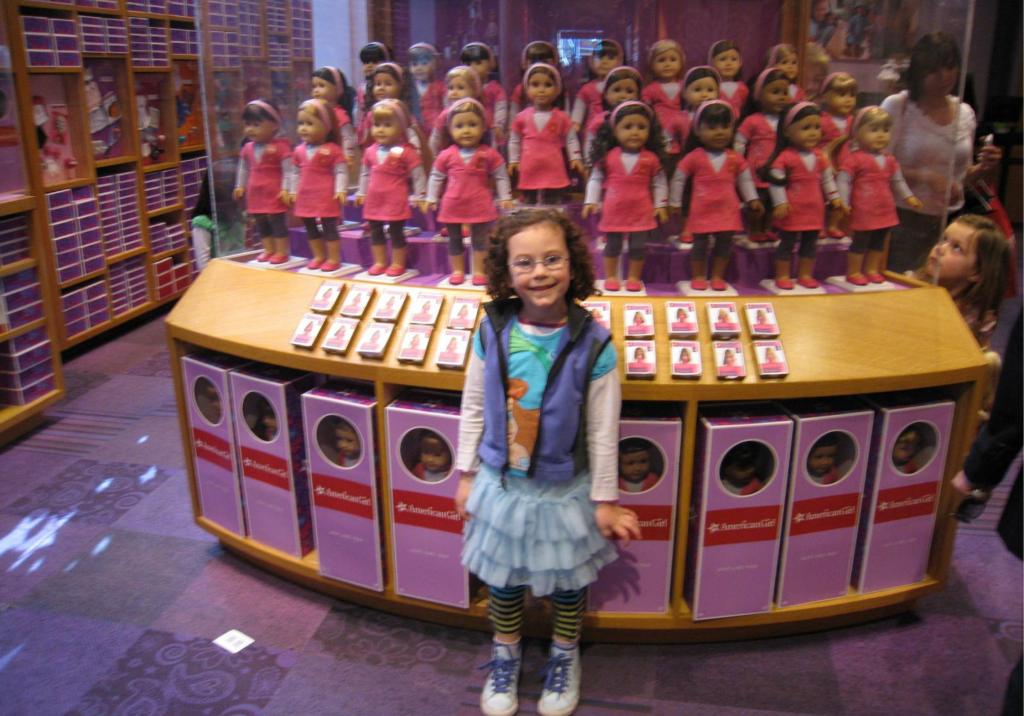
Image Credit: Me at age 6 in the American Girl Doll store on a trip to Manhattan for my birthday. Taken by Maria Pietrosante, my mother, in April of 2010.
As a young girl, I was not allowed to wear makeup. I didn’t understand why then, but from the age of 13 on, I started to stare the reason straight in the face as I put on mascara before school. Once I started “enhancing” – more so covering up – my natural features with makeup, I found I couldn’t go back to the way I saw myself before. Before I knew it, my self-perception had been permanently altered. It took seven years before I could look at my natural face with anywhere close to the same kindness I had shown it before.
It had been quite some time since the last occasion I considered going makeup-free in public before I came across a video online defining the aesthetic of the ‘New York 10’. The video discussed a university student’s observations on a subgenre of this niche: young women who live in New York City and attend prestigious universities like Columbia and Barnard. One of the key points was that these young women were often bare-faced, or wearing a minimal amount of makeup. The creator claimed, “The face card is the outfit,” implying these women are so naturally beautiful that they don’t need anything to enhance their features.
As a woman who never thought to leave my face untouched before leaving the house, I became entranced by the idea. Perhaps I could get myself to experience the comfort of makeup-free days whilst retaining the security I had about my looks when I wore a full face. The next day, I embraced my natural features. It felt amazing, especially as going out bare-faced became something of a trend. When I rolled out of bed and went straight to work without mascara or blush, I wasn’t being lazy; I was Carolyn Bessette-Kennedy, or Serena Van Der Woodsen, or a ‘New York 10’. I wasn’t careless, I was effortless. Perhaps what I really wanted to be was carefree – but that was not yet within my reach. Either way, I appreciated the perceived freedom I had gained by learning to love my natural features a little more each day as I became used to what I actually looked like without makeup. It was more of an adjustment than one might think, and a welcome one.
I say perceived freedom because it wasn’t really freedom at all. I could only allow myself the comfort of a makeup-free day out if I were pretending to be something I wasn’t, whether that be an it-girl of Kennedys past, an Ivy League heiress, or something indescribable I couldn’t hope to ever live up to. I rarely considered that, to any passerby on the street, no one would have looked at me and thought: Wow, very Upper West Side! Several months passed before I gave that idea more thought.
There has been prominent dialogue in the last year or so concerning the Gen Z conservative pipeline following the return of the tradwife aesthetic, Lolita-esque coquettes, and the political stances of powerful Western nations. The female appearance is an ancient way to control the populace and represent conservative values, and not even going makeupless is free from this truth.
Wearing bold or stylized makeup shows personality in a unique, individualised way. It signals to a woman’s peers that she thinks a certain way, such as through affiliation with a subculture like punk or goth. Heavy eye and face makeup to express involvement with subcultures like these, which have sociopolitical connotations along with love for the music, indicate not just one’s taste but their political beliefs as well. When you’re not wearing makeup, you can’t use graphic eyeliner to signal instantly to others about your opinions; when you’re not wearing makeup, you can’t use your looks to rebel.
This is not to say that a woman who doesn’t wear makeup can’t express to others that she has certain beliefs, or that going makeup-free is conservative in and of itself; however, a la Margaret Atwood’s revolution from her novel The Robber Bride (1993) that every way a woman behaves can be traced back to a “male fantasy,” we must take a further look into why certain aesthetics are being pushed in our current political climate. Why are we now being advertised the ‘tradwife’ and ‘clean girl’ aesthetics, what to buy to achieve them, and how to behave to participate in them?
Tradwife, popularised in part by 23-year-old Mormon model Nara Smith who spends hours cooking meals from scratch for her husband and three kids, is quite glaring in terms of its patriarchal influences. Along with videos of self-proclaimed “stay-at-home girlfriends,” the normalisation of “casual” sex work via OnlyFans, and the idea that young women should marry rich and quit their jobs under the guise of never settling, this aesthetic is clear in terms of its aims. Dating back to the 1950s nuclear family ideals, it doesn’t take much to determine that those who advertise it to young women mean to control them.
The ‘clean girl’ aesthetic, however, was popular for several months before anyone started questioning it. The Clean Girl does a 9-step skincare routine each morning and night, wears neutral colours complemented only by pale pink and the occasional pastel, does pilates, and drinks matcha. She has clear skin, is impossibly thin, and judged by her proximity to whiteness and the degree to which she can toe the line of fetishising East Asian culture without getting “cancelled” over it. The clean girl, though she doesn’t wear heavy makeup if she wears any at all, must purchase luxury products deemed “high-quality” by influencers with no merit to achieve her “Korean glass skin,” invest in a daily matcha latte, pay for pilates classes to attend in the early mornings, and have her whole life decluttered to immerse herself completely in the aesthetic. This ideal is unachievable, but many young women subject to impossible standards from the day they were born would die striving for the clean girl’s prim and controlled perfection.
Young women are lulled into boxes like the tradwife and clean girl aesthetics and we go willingly. Why? Because we have been taught to believe our whole lives that being desirable to men is the only way to survive, and is oftentimes the key to being happy – even if that happiness is ever-fleeting and subject to degradation. Through these aesthetics, we are influenced to buy into them with our hard-earned money, lose weight through drastic measures, and above all to think and behave a certain way that lines up with the desired – and unachievable – result. When we subscribe to these beliefs and aesthetics, we give up a part of our power in them. When we lose who we are and what we believe in, we can be controlled. The woman who starves herself to be skinny will more likely need to be carried than if she had eaten enough to sustain herself – and she has no control over where she will be carried to.
The blame is not on the young women and girls who are constantly bombarded with advertisements, influencers, and unachievable standards to strive for. I myself have fallen for these ploys countless times. When I stopped wearing makeup to be more like a New York City heiress – a woman I was not, and never will be – I convinced myself that I needed to purchase more skincare so that I could feel more confident without base makeup. I followed trends that made me feel terrible about myself, even as I became more secure in my natural beauty. Even though I’d been aware of them for years, I was still noticing the feelings and beliefs I had harboured since I was a young girl. If I didn’t live up to the harsh standards of beauty I’d set for myself countless years ago for even a glance in the mirror, not only could I not bear letting anyone see my face – I couldn’t even live with it myself. When it struck me that I only felt desirable without makeup because I was pretending to be someone I considered even more desirable, I was overwhelmed with grief. I could only picture my childhood self, with her goofy smile filled with crooked teeth I later had fixed and short curly ringlets that I began to straighten early into my adolescence. She doesn’t even feel like me.
It is a complex thing to be a woman in our modern age, and it always has been. With today’s already polarising political climate further magnified by social media, it has grown especially difficult to discern how to feel about everything we’re assailed with every time we read the news or open Instagram; however, I remain optimistic. Every time I find myself getting cynical, something soon reminds me there is hope yet. It’s not a crime to romanticise the day-to-day, especially if it removes you just a little from your comfort zone. Six months ago, I never would have stepped outside the house without a full face of makeup complete with eyeliner and mascara; now, I spend most days without anything on my face at all. I’ve learned to prioritise my own comfort and self-esteem, even if the idea of being Carolyn Bessette-Kennedy lingers. Most days, that’s enough.




Leave a comment