


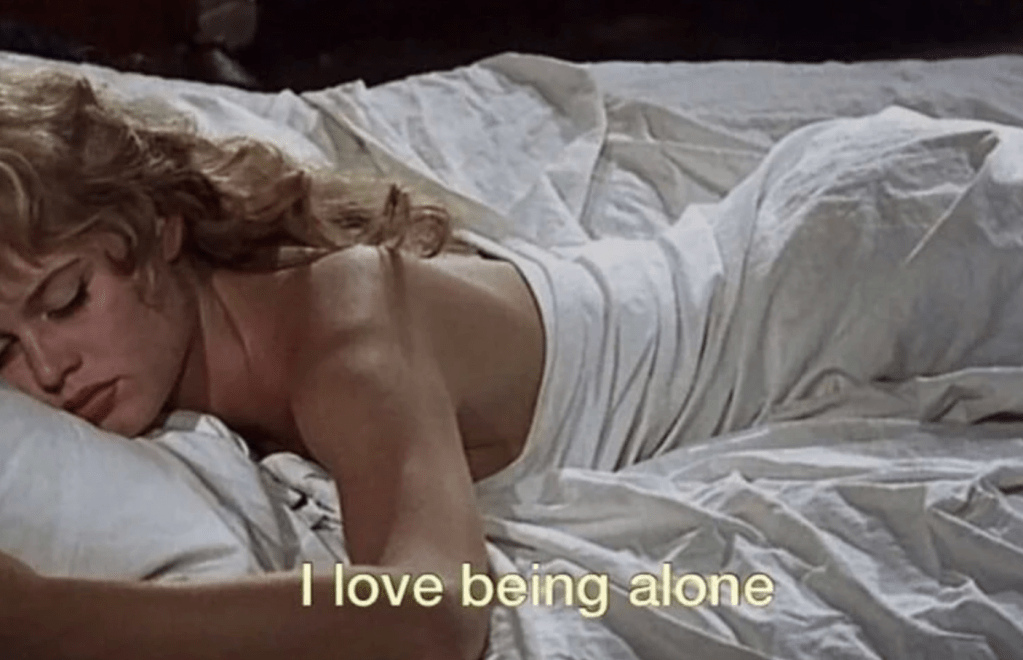
Image Credit: Agnes Varda, Cleo de 5 a 7 (1962)
The Male Gaze was a term created by cinema critic Laura Mulvey as she commented on the way women were presented on the screen. It refers to both the man behind the camera and the audience viewing it, as the actresses serve a purpose outside of the constraints of the story. They are there to be forcibly sexualised in a way that often takes them away from their personhood and into an object that sells tickets. I, myself, am a victim of this as I look towards the silver screen and then into my own mirror and find nothing to feel proud of. This does not just impact the actress portraying the character, but the men and women as they take this perception into the real world.
My favourite example of this is the infamous scene in Transformers (2007) where Megan Fox is bent over a car she is fixing, with Shia LaBeouf’s eyes lingering on her body, and along with it, so does the camera. There is no doubt that Megan Fox is an unbelievably attractive woman with a body that 2000s tabloids would have claimed every woman should aim for. However, the films she is in are presenting her as if that is all she is. In fact, during the promotion of Jennifer’s Body (2009), Fox stated that they wanted to use her appearance to sell the film to young men, despite the themes of the film directly contradicting this. All this led to Fox having a “genuine psychological breakdown” at the fear of being seen by both men and women alike, and to be extremely loved and hated for her looks.
The way actresses are presented on screen can only be a reflection of how they are treated on set. Alfred Hitchcock always had a beautiful woman in his films and he treated all but Grace Kelly appallingly. The Male Gaze does not just represent the thought of man, but the action of man too.
The media that we consume has an incredible impact on how we view one another and it is clear that if we view women as objects enough we will start to believe and act upon it. How can we be shocked that teenage girls are desperate for male attention when the media we are consuming states that is the core of their value? However, women are not to blame for following, but the directors, such as Hitchcock, for setting a precedent that devastates women everywhere.
As the screens became smaller, the term ‘Male Gaze’ has become overused and misunderstood by people on social media, alongside similar words like ‘gaslighting’, with the purpose of voicing frustrations of the patriarchal society that constrains us. Some particularly offensive uses are done by women themselves, as they describe some women as conforming to the Male Gaze because they wear heavy make-up and dress immodestly. A term that was once used to help women is enforcing even more rules on how to be accepted.
Out of this trend came the term ‘Female Gaze’ which outlines an appearance that is purposefully against the Male Gaze by dressing how you would if you weren’t trying to attract a man. However, this term cannot exist because there is no matriarchal structure enforcing it. These terms are not made for the real world and only make women more divided as we judge one another based on how “feminist” we are. A woman cannot conform to the Male Gaze as she is not the one in control. A man is not “written by women”, he just has basic decency. These terms are made for cinema because it is something that can be controlled, analysed and changed. Applying them to real people is counterproductive and does a lot more harm than good.
Nevertheless, not all films present women in such an objective fashion and there are plenty that face these themes head-on. One of the most iconic is Agnes Varda’s Cleo de 5 a 7 (1962), which has a clear split between a woman presented through the Male Gaze and then escaping from it, especially as it is directed by a woman. Portrait of a Lady on Fire (2019) is another example of this, as two women find love together without any men being involved within the plot. Both films don’t deny the patriarchal structures that control their lives but present them in a way that feels like freedom. The only solution to the Male Gaze is for women to have more roles behind the camera, with currently only 16% of the highest-grossing films of 2024 being directed by women. It is up to us to make the difference and be the writers and directors and actors who demand something more for ourselves and future generations of women.



Leave a comment