


Image Credit: Esme Rose Mathialahan
Sat sipping an espresso, outside, observing the traffic and markets along the Grands Boulevards. A woman in a knee-length polka dot dress, paired with what I can only describe as wellington boots, glides past. Eyes shaded by black-rimmed sunglasses and a black clutch under one arm. Then, people cascaded over the crossing and she was gone.
I couldn’t help but wonder what life she led in Paris. The city of lights and love.
In such a globally renowned location of designer labels and fashion etiquette, I was in awe of daring layers of texture, pattern and accessories.
A pink tie used as a belt over a white shirt, with pink ballet flats to match.
A flowing dress over straight leg, plain-hem trousers.
A woman cycling in a mass of tulle skirts and heeled sandals.
The city’s grace and constant energy were electrifying. As I walked towards Musée du Louvre, I couldn’t help but marvel at the expanses of human history the city walls had witnessed. Surrounded by architectural wonders and art, a new exhibition caught my eye: ‘Louvre Couture’, shown January to August 2025 in the Department of Decorative Arts. 100 contemporary fashion pieces and accessories (1961-present) from 45 fashion houses, in dialogue with the decorous rooms of Napoleon III’s apartments and art dating from the Byzantine era to the Second Empire. Pieces expressed an intimate knowledge of the museum’s artefacts or were inspired by the history of decorative styles explored by the department. The exhibition offered a new perspective on visual culture and decorative art through the lens of contemporary fashion design.

Synotopia
The Louvre was a palace before it became a museum. The most intriguing pieces for comparative purposes, I think, are those displayed in the Grand Salon in the apartment of the Ministry of State. As shown in the image above, luscious red velvet, gilded bronze and cut crystal chandeliers were the epitome of decorative interior design during the Second Empire (1852-1870). The intricate detailing on walls, ceiling and furniture were breathtaking. A reception room intended for high society’s art of conviviality.
Left of the entrance stood ‘Syntopia’, an Iris Van Herpen piece from her 2018 Autumn collection – “a dress of silk organza, laser-cut crepe, Mylar and stainless steel.” The dress transforms the wearer into a bird; it has a paradoxical combination of volume and lightness, in keeping with the fashions of the Second Empire. Its ethereal architecture is in reference to chronophotography, where multiple images of a moving subject are taken at regular intervals and then combined into a single or series of images. In the dress’s reflections of golden lighting, it can be imagined to flutter, imitating the movement of feathers when worn. Initially, the symbolism of a bird, a sign of peace and liberty, seemed at odds with the intoxicating wealth and power the room was intended to express. But upon closer consideration, the bold colouring of red and gold furniture populating the large room offers the imagination whispered intimacies between friends and enemies alike, whilst dazzling smiles thrown out to the room hide a multitude. This performance of high society, matched with the lavish design of the room, offers a paradox in its own right. Success marred by gossip and triviality. Perhaps in their mutual allusion to contradictions, the history of the room and the ‘Syntopia’ dress form a connection. That things aren’t always what they seem.
However, a peculiar spherical silver dress sat tucked away behind a plant that was centred in the room. It didn’t behold any secrets. It formed a jarring contrast with the gold room. From the Jacquemas 2023 Autumn collection “the dress is embroidered with metallic flowers and adorned with crystals. The simple shape makes an abstract reference to the opulence of the Louvre Palace and the Palace of Versailles.” Perhaps the distance between viewer and garment prevented the intricacies of the dress to be appreciated. Unfortunately, it couldn’t compete with the majesty of the room nor its surrounding displays. As the proximity of each design encourages comparison to be made, not only of the design and Louvre history, but also to each other.
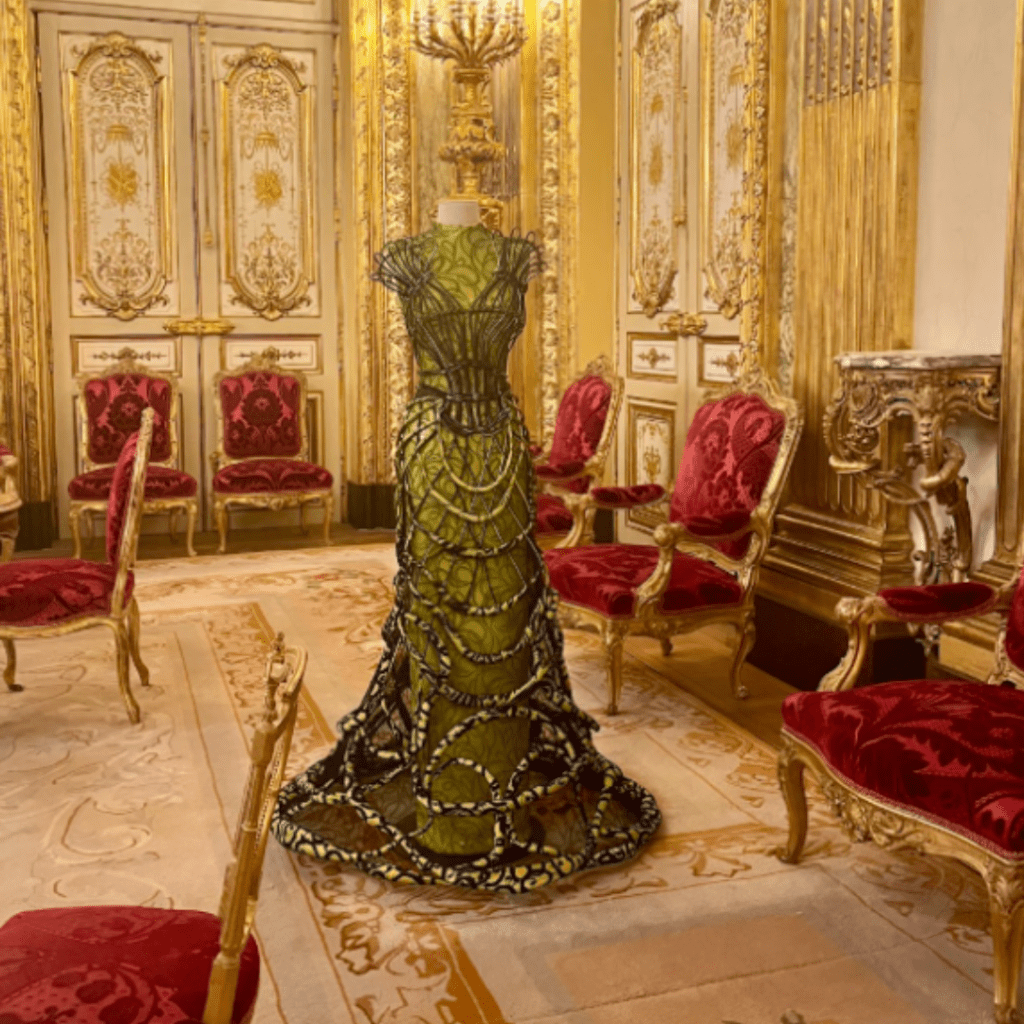
I was more interested in the third and final dress showcased in the Grand Salon, to the left of the exit. The Jean Paul Gaultier piece, from the 2008 Autumn collection, was eye-catching in its structural uniqueness. The pear-green of the sheath dress in chiffon and sequins, covered with fine lace, formed an echo of the single plant in the gilded space. According to the museum, it was “worn under a long dress comprised of a ‘wicker mannequin’ bust cage and skirt structure of canary silk satin and merle with pronounced serpentine volutes.” The cage was a direct reference to crinoline, a popular 19th century structural garment worn under the skirt to lend it fullness. The snakelike swirling pattern is perhaps accordant with the hunger for exoticism and colonial adventure during the expansion of empires. As in another play with paradox, the structural element traditionally worn under the dress is instead exposed in bright colour and pattern, evoking the lavish decoration desired in the late 19th century.

Jacquemas
Jean Paul Gaultier
Cathedral Dress
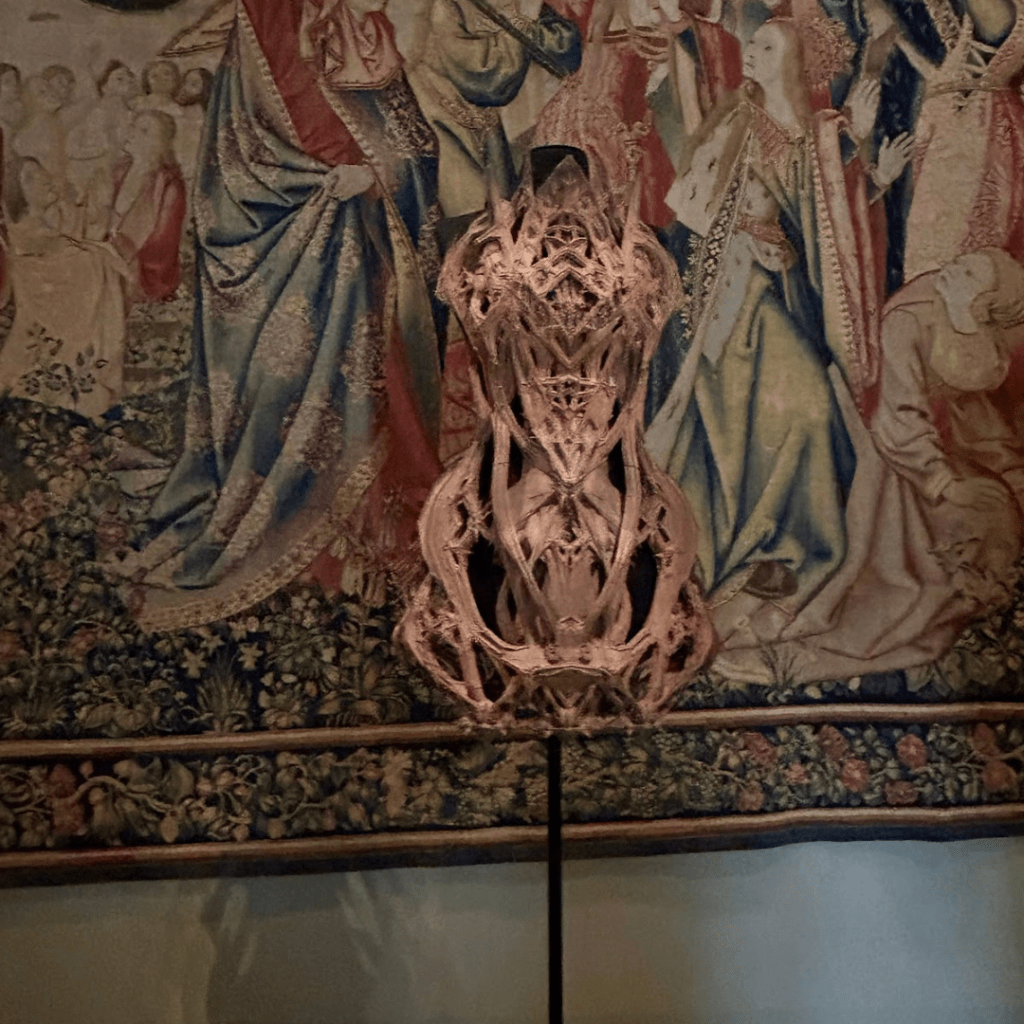
Of course, there were countless other dazzling pieces, and a special mention must go to the ‘Cathedral Dress’ from Iris Van Herpen’s Spring 2012 Couture collection. Van Herpen is renowned for her avant-garde designs, which seamlessly blend haute couture with cutting-edge technologies. The Maison of Iris Van Herpen states that “organic innovative femininity is expressed through state-of-the-art Couture that embraces individuality powerfully and fearlessly.” I think this is clear in the majesty of the ‘Cathedral Dress’. According to the Louvre museum, the piece is made of 3D SLS printed polyamide with copper electroplating, “it’s slender structure of curves and counter curves evoking a Flamboyant Gothic style nurtured by imagination.” The dress’ pointed neckline evokes the pointed arches and flying buttresses common to Gothic architecture. I think its firm frame, paired with open spacing between the polyamide, allows the dress to seem both monumental and elegant.
These wearable pieces of art are spellbinding; each expresses an elaborate sense of empowerment and beauty. Yet despite seeing swathes of silk, technological discovery and history reminisced upon in creative cuts of fabric, I’m still thinking of the fabulous pairing of the polka dot dress and wellington boots.




Leave a comment