


Image Credit: Josie Barry
Shades are definitely advisable in this blingtacular exhibition of some of Cartier’s most blingtastic jewels. 350 objects, including timepieces, spread through a series of themed rooms. The best till last – the tiara room – because Ladies… you can never have too many handbags, shoes and well … tiaras. Who hasn’t popped on their Disney Princess equivalent and unquestioningly knew – yes… I’m definitely having one of these one day. Then this exhibition is for you.
Apart from The Crown Jewels displayed at The Tower of London – I don’t know of another opportunity to be surrounded by such an array of sparkling gemstones of every hue and size. In fact, I became so quickly complacent that I began to irrationally critique as though in a window of H. Samuels – that 311 carats Sapphire, owned by Princess Victoria Melita of Saxe Coburg and Gotha, Grand Duchess Kirill of Russia, really isn’t a patch on the 478 carats, sold to King Ferdinand of Romania as a present for his wife, Queen Marie. Don’t you agree? And there’s the rub. In an age when the future Queen of Great Britain, (that’s Kate Middleton to you and me) thought it too ostentatious to wear any form of tiara to King Charles’ coronation – who the blooming hell is wearing this stuff?
It’s worth discounting the waffle around the gems and taking the time, as though in an art gallery, to study as many pieces as possible. Whether you’re drawn to a favourite design or the sheer magnificence and scale of a piece such as Maharaja Bhupinder Singh of Patiala’s ceremonial necklace, (yes the biggest for the blokes – go figure…) you come to appreciate the mastery and skill it takes to create these pieces of art. Although based in Paris, London and New York, Cartier designers drew inspiration from all over the world, including China, Iran and Egypt, to create pieces for their demanding clientele.
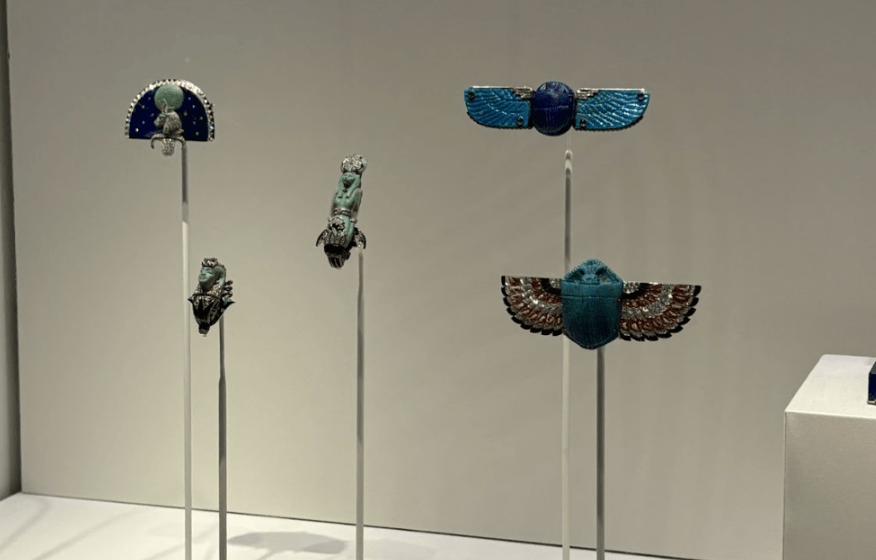
Image Credit: Josie Barry
It is clear from the accreditations, that the majority of the pieces, if not in the V&A collection, are tucked away with private collectors. I like to imagine them in a wood panelled, airless room with a Renoir on the wall, stroking a Persian cat whilst drinking a martini, adorned head to toe in their gems with nowhere to go. Because that is the overwhelming sense of where these historical pieces belong and that is – to history. Even the more modern creations seem statement pieces, to create a buzz around the brand to buoy sales lower down the chain, as catwalk fashion collections are to bags and fragrances, where they actually make the money. When we think about where we see such abundance of gems outside of royalty, it is, conversely, on the humble, vulgar celebrity tottering down the red carpet. Such as Kim Kardashian – attending court after an £8 million robbery of her jewellery, according to Style Magazine, ‘dripping in diamonds…’ And there’s Rhianna… the Diva of our time… bright as a diamond… adorning the cover of W magazine in a Cartier tiara, also on show at the exhibition.
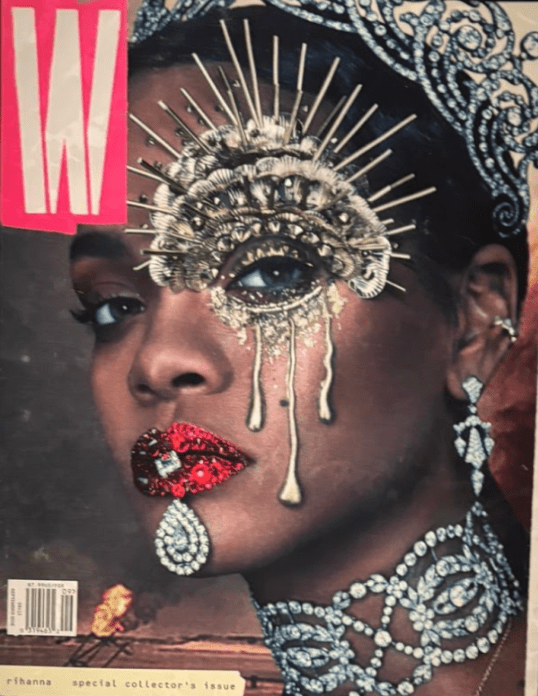
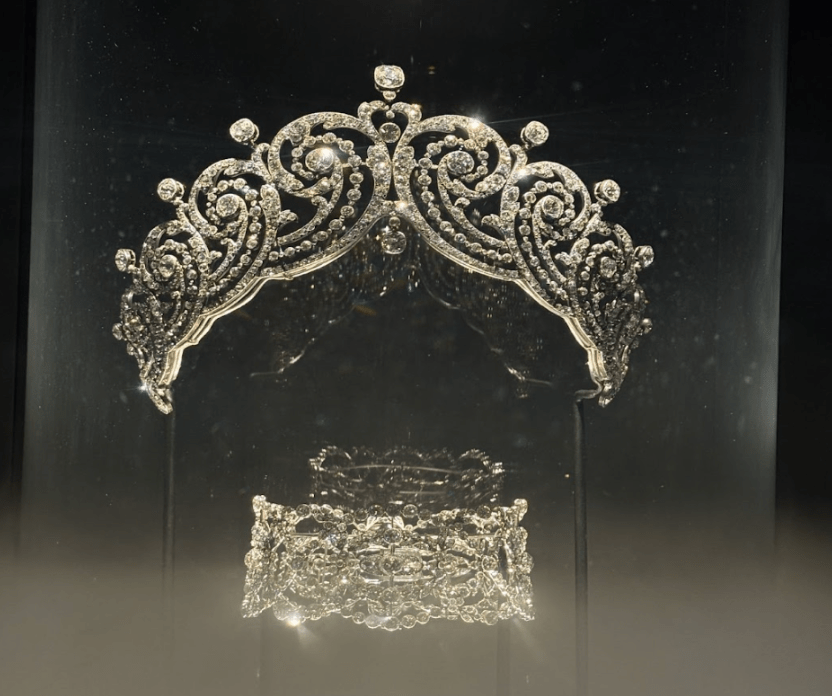
Image Credit: Josie Barry
The contributing factor towards the pricelessness of these objects or the sum of their parts, is undoubtedly my favourite discovery of the exhibition and that is the story behind each piece. When we are presented with a tiara commissioned by The Dowager (for those who haven’t watched Downton – that’s the title bestowed on a widowed Duchess) Duchess of Manchester, we know something’s amiss. Manchester…? Seriously… Then we discover that she was one of the many American ‘dollar princesses,’ who married into the British aristocracy, exchanging their wealth for a title. From the look of the 1500 diamonds, it was probably a fair exchange for a crusty old Duke. The tiara was eventually surrendered to HMRC in lieu of inheritance taxes – maybe that’s behind Racheal Reeves’ latest strategy (note to mother – check heirlooms in the loft).
One of the most fascinating stories and famous collections is The Duchess of Windsor’s. For those living under a rock – The Duke of Windsor was in fact Edward VIII – uncle to Queen Elizabeth II. He chose to abdicate to marry an American divorcee and therefore thrusting his ill-prepared brother, George VI – the Late Queen’s father – into the frame. Although George proved his worth – during WWII, when the monarchy came into its own and contributed to lifting the morale of the nation (the Queen Mother particularly irritated Hitler), the weight of his office undoubtedly caused his premature death in his mid-fifties. His family never forgave The Windsors. If fellow outcasts, Megan and Harry come to mind, apart from both duchesses sending cards signed with the full flourish of their titles – that’s where the similarity ends. The Duke of Windsor was no broke ‘spare’ and his wife was no jam-maker. He continued to live the opulent life he thought he was entitled to and often showered his much maligned wife with commissioned pieces from Cartier. On display are some of her signature choices including those from the panther collection and the iconic flamingo brooch.
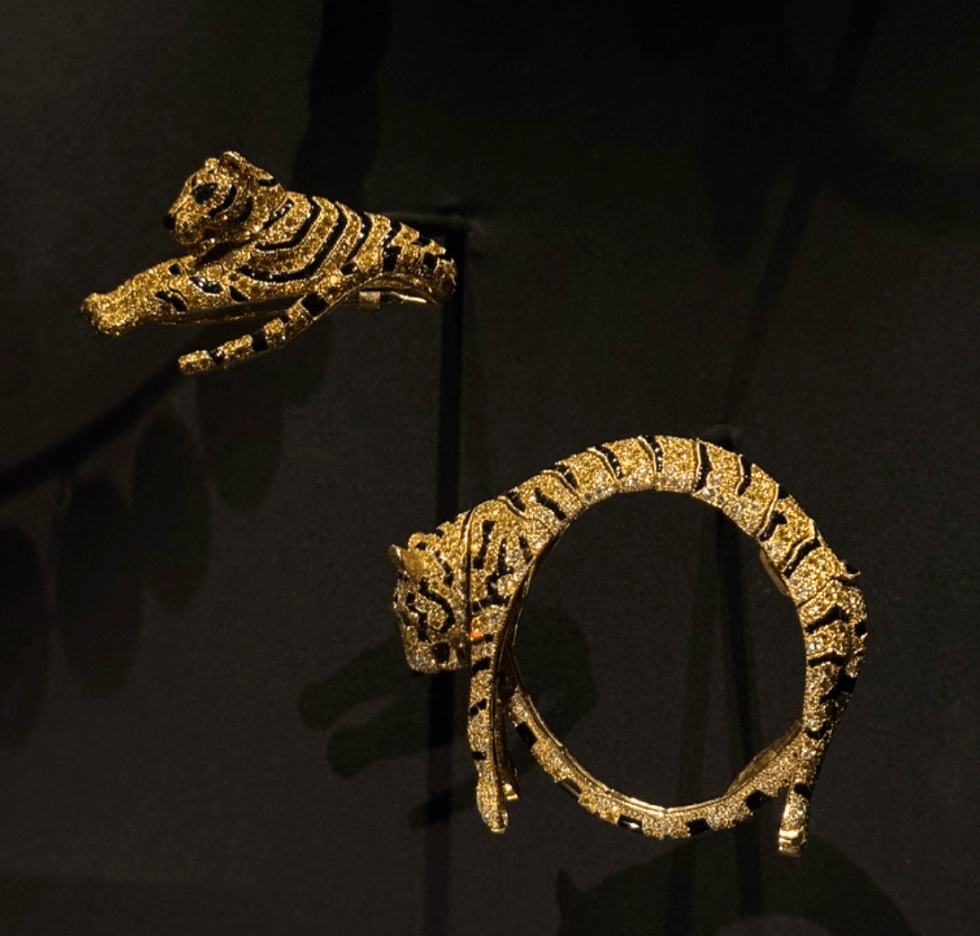
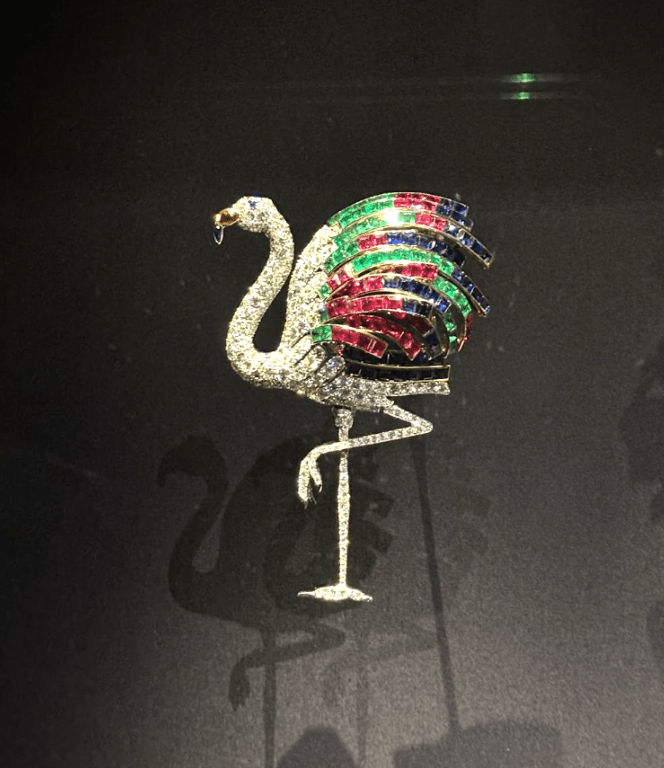
Image Credit: Josie Barry
Staying on the subject of ‘spares,’ who can forget the glamorous sister of our late Queen, Princess Margaret. With her movie star looks, she was a magnet for the fashion houses and acquired her own collection of rocks. We see at the exhibition, one of her more modest but most meaningful pieces – a diamond rose brooch in honour of her middle name, given to her by her father and worn throughout her life.
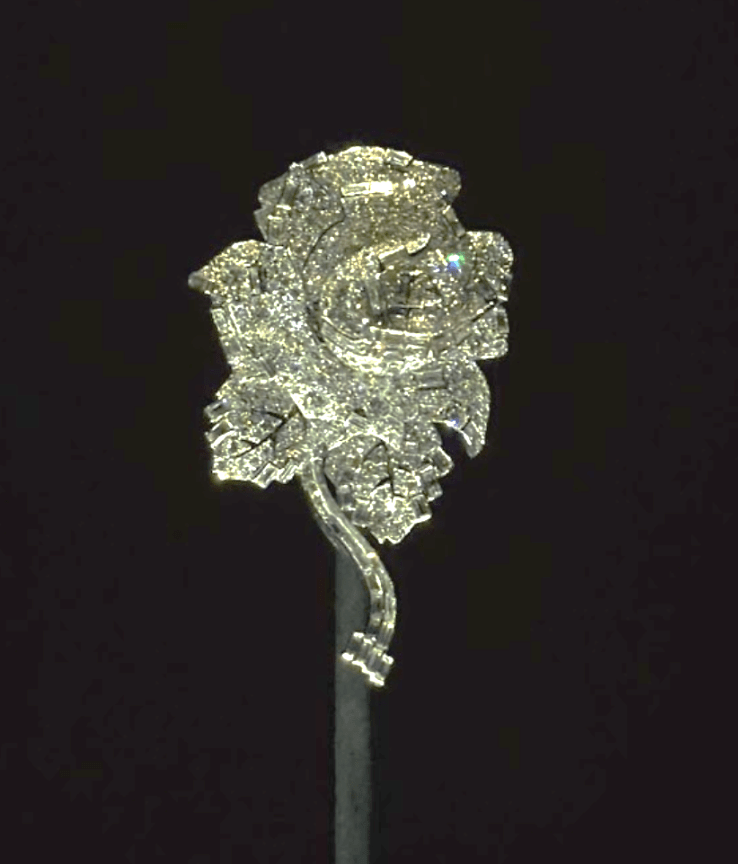
Image Credit: Josie Barry
The exhibition also gives pause to the origins of the stones and at what cost they are mined. It will come as no surprise that they are mined from the most impoverished countries and it’s not a leap of imagination to conjure up the conditions, including: emeralds from Columbia, rubies and pearls from Myanmar, sapphires from Sri Lanka, pearls from The Gulf, diamonds from India, Brazil and South Africa. The exhibition tells a story reflecting this of The Star of the South diamond (128 carats), found in 1853 in Brazil by an enslaved woman. She was granted her freedom and a pension for her discovery. The diamond was in the collection of the Maharajas of Baroda for nearly 80 years and was acquired by Cartier in 2002.
This is an exhibition for and about women (warning – male visitors – don’t irritate the female visitors by hogging the view of the cases). Women’s stories lie behind the majority of pieces, their history and imagined intent. Whether a show of status, a husband compensating a connection for an arranged marriage, a love token or a running away fund. Then the representation as the peak of glamour in the 1920s and 1930s. Later in the 1950s, embodied by the likes of Hollywood royalty – Grace Kelly and Elizabeth Taylor. The shift to the nouveau riche or celebrities of today, devalued the desirability as their ostentatiousness is perceived vulgarity. There’s no getting away from the fact that the world has changed. The ethics of gem-mining and the Western World’s self-awareness of the plight of others, undoubtedly has killed this market but the wonder of what humans can craft from raw stone and the stories and lives behind these gems, is definitely worth a look.
Image Credit: Josie Barry
Cartier Exhibition V&A South Kensington
Closes Sunday 16th November 2025
Tickets £27 to £29, Members free





Leave a comment