

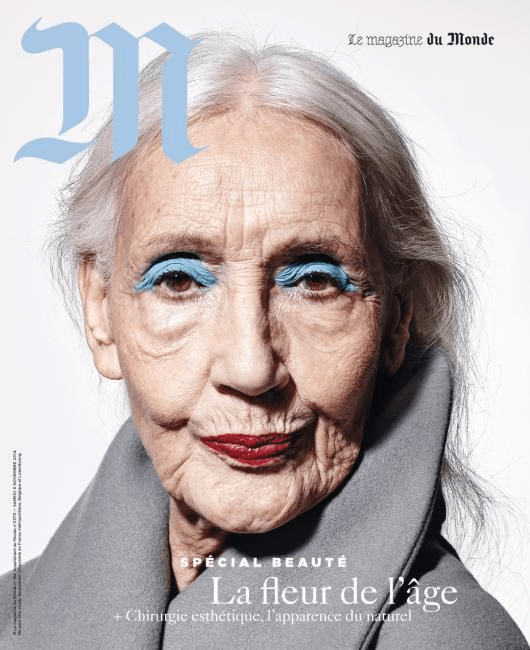
Image credit: M (France)
I have various memories of being a little girl and rummaging through my mum’s makeup and skincare, wondering to myself what ‘anti-wrinkle technology’ and ‘revitalift’ meant. I tried some on one day and to my surprise, that one miniscule smile line didn’t disappear or reduce overnight. I guess that’s the hope these skincare companies want us to have, and one that keeps us buying more in case one day it all pays off. To younger me, wrinkles had not crossed my mind as something to be reversed and as I’ve gotten older I wonder why women (mainly) pay for fads that make unrealistic promises these skincare companies can’t keep.
Now I understand it is not women that should bear the brunt, but these companies for perpetuating this harmful notion that aging is bad. And this isn’t to say we shouldn’t take care of our skin too, I’m an advocate for wearing SPF everyday, even when the sun isn’t shining outside. But it’s one thing protecting your skin from UVA which can lead to skin cancer, and another using creams to “fight” your wrinkles which pose no threat at all. Women are already held to impossible standards that tell us we should look eternally youthful to stay attractive, and companies found a way to profit from this insecurity instilled into all of us from a young age. Though anti-aging skincare products are largely marketed towards women, anti-wrinkle creams for men (as if the ingredients are that different) are popping up on skincare brands’ catalogues now too.
L’Oreal Paris’ ‘Men Expert Wrinkle Decrease Moisturiser’ claims that it “targets wrinkles to reduce their appearance” with a formula “especially designed for men’s skin”. I can’t help but wonder if this is them trying to level the playing field, as if to say “we’re not playing into patriarchal expectations because we’re including men too,” or if they truly saw an untapped market that could increase profit (probably both). The language used in its marketing holds a negative tone too–why do wrinkles need to be “targeted”? Aging is a natural process that happens to all things in life, though some more visibly. A banana goes brown within a week because it oxidises quickly, the air ages it at a rapid rate. The flower on your windowsill will die within a month, its petals will fall off and you’ll simply bin and replace it without thinking twice. Our pets get old, their skin gets loose and their hair begins to grey but we don’t love them any less for this. So why are we so hard on ourselves?
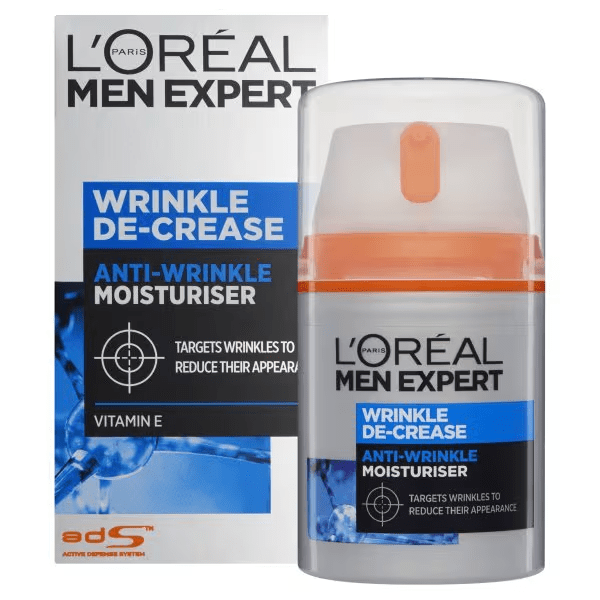
Image credit: Superdrug
Discussions about human aging in the West have been had since the days of philosophers Aristotle and Seneca when aging was considered a “natural disease”. However, Claudius Galen (who the National Library of Medicine deem the greatest classical writer on medical matters) countered this in the years c.130-c.210 AD, arguing that aging cannot be a disease as it’s a universal experience. Instead, Galen deemed aging a “natural process”. Many cultures have differing perspectives on aging, but the West seems to have a particularly strong grip on the perspective of aging as something to be reversed or paused. From Elizabethan era women covering their faces with white, lead-filled paints to cover up their patchy complexions (due to the skin damage already done by said paints) and to flaunt that they have avoided the sun, to the viral “anti-wrinkle straw,” there’s not a whole lot of difference. Both inhibit women’s ability to live and move naturally; harmful and toxic foundations meant women had to stay poker-faced while it dried so as to not crease it and ruin the “flawless” look. Anti-wrinkle straws require you to purse your lips at the top of the straw which looks, and must feel, completely unnatural. This caused uproar on TikTok and rightfully so, what dystopian world are we living in where we can’t drink from a straw without fear of developing wrinkles?
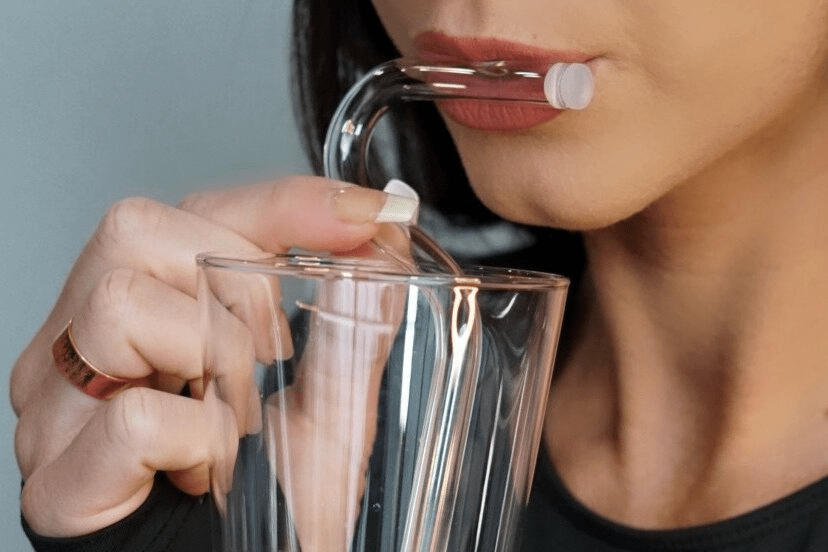
Image credit: New York Times, Lipzi Straws
I believe this contributes to the hyper-consumerist culture we find ourselves in today, where more and more insecurities are constructed to then sell a new product. It reminds me of the Instagram story by actress Jemima Kirke that went viral in which she said, “I think you guys might be thinking about yourselves too much,” in response to someone asking for advice to unconfident young women. Although introspection is important and a lack of confidence is something we all experience at one point or another, I would have to agree with Kirke. When you start looking outwards as much as you look inwards, wrinkles and loose skin become the least of your worries. I do acknowledge, however, that as a 20 year old this isn’t something I necessarily face the reality of just yet in terms of ageing. Ageism is real and women especially experience this in wider society, particularly in the workplace.
This likely links to the acceleration of cosmetic surgery, procedures once reserved for the rich and famous are now not too far out of reach from the rest of us if we really want to live our own Dorian Gray fantasy. Cosmetic surgery is often done for aesthetic reasons, but with ageism in mind, it may be a way for women to avoid prejudice in the workplace. For this, I’d once again criticise capitalism (always at the scene of the crime) and the patriarchy, two forces that intertwine and inevitably instill a hyper-awareness about physical appearance into women. We must maintain youthfulness, peak productivity, and attractiveness all at the same time, all of the time.
The most alarming phenomenon to me is how our perspective of aging as unattractive and undesirable is steadily getting stronger. In an article by ELLE magazine titled “millennials are changing what 40 looks like,” Berohn notes “as millennials reach so-called middle age, no one seems to be looking or ‘acting’ their age anymore”. This comes after Anne Hathaway’s casting as a mother in The Idea of You (2024) raised concerns surrounding Hathaway’s looks being too youthful to represent a mother despite her being 40 (the same age as her character in the film). Anne Hathaway doesn’t seem to have aged a day since her The Devil Wears Prada (2006) days, and though some people naturally age slower than others, the casual use of plastic surgery means our perceptions of aging are being skewed by those in social media as well as singers and actors. Botox, for example, also impacts on our display of emotions and inhibits frowning or raising eyebrows, something which is central to the human experience. If we look at actors who have gotten botox, it adds an uncanny feeling when the actor sounds like they’re crying but their face is frozen still. Erasing frown lines and ‘crow’s feet’ however, seems to be a suitable sacrifice in the pursuit of youthful beauty.
It’s easy to focus on the appearance-based side of aging and the beauty within it, but arguably the true beauty of aging lies largely in the wisdom and experience that develops with it. From the relationships you build, the places you see, and the knowledge you acquire, getting old comes with invaluable benefits. I guarantee you’ve had the same experience of hearing an older family member recount various stories of years gone by, and probably rolled your eyes in the moment. When you’re young, these moments of reminiscing sound more like a bore than someone’s true lived experience. But when we’re older we’ll probably find ourselves doing just the same, which I think is a sign of a life lived fully (as long as it’s not all you talk about). And I doubt at any point we will remember exactly what we looked like in those moments, with or without wrinkles.
Ultimately, to age is a privilege and a gift, one that not everyone has the chance of experiencing. I think that has become lost somewhere along the way between 9 to 5 work days that result in the healthiness of our bodies getting knocked down the list of our priorities and the fact that we take aging for granted. Social media and the entertainment industries have us examining our faces in the mirror and buying products we don’t need to stay looking young. But we shouldn’t fear aging, if anything we should fear not aging, because that would mean we haven’t lived to our fullest and most fulfilling capacity.


Leave a comment