

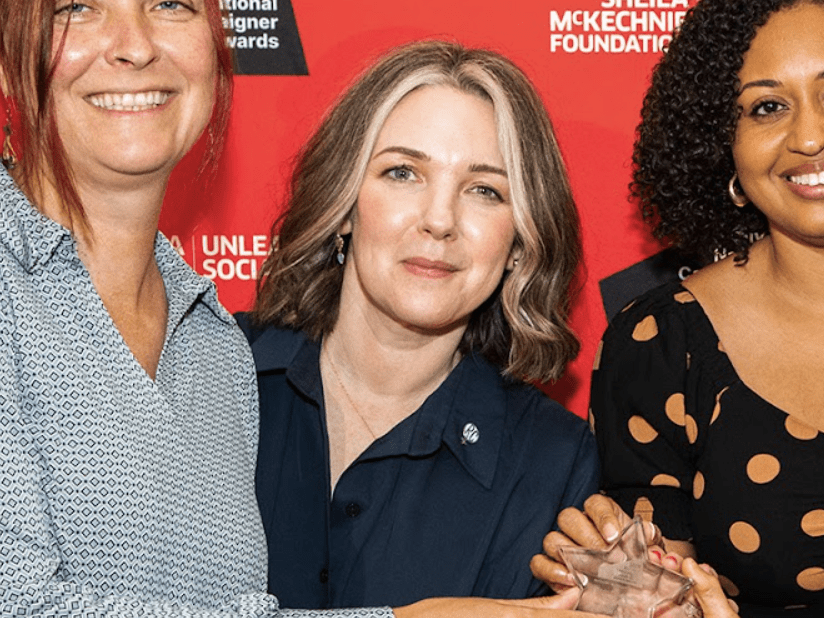
Image Credit: Ciara Bergman, pictured centre
A list of useful links can be found at the bottom of the article.
More than one in four women have been raped or sexually assaulted as an adult. A horrific and, yet, well-known fact. Lesser known, are the efforts of feminist charity Rape Crisis England & Wales (E&W), and their CEO Ciara Bergman, to end sexual violence and abuse.
Rape Crisis E&W’s primary aim is the protection and support of those subjected to sexual violence and abuse. This is achieved by raising awareness, campaigning for Rape Crisis Centres to receive the necessary funding, ensuring the Government fulfil their responsibilities to survivors, and that perpetrators are dealt with effectively. Bergman’s experience and key position within the movement is valuable in helping combat the widespread issue and ignorance of the UK’s Rape Crisis.
Bergman was gracious in affording Gurlish the opportunity to discuss her work and the importance of Rape Crisis E&W’s mission. I was particularly interested in what led her to take on such a life-affirming role.
Bergman told me how her career has been shaped by a lifelong engagement with injustice — from witnessing bullying as a child, to studying psychology at university, and later pursuing a postgraduate diploma in therapeutic work. Early in her career, she worked on the resettlement of men who had committed serious violent offences, delivering both group and one-to-one interventions for perpetrators of domestic abuse.
“I’ve always worked on the basis that no matter how challenging someone’s life or circumstances may be, they’re still responsible for their abusive behaviour, […] women and children’s safety and freedom must always be the focus of that work.”
Ciara Bergman to Gurlish
She then explained how she went on to work across a range of roles in the third sector (not-for-profit), supporting women affected by abuse. But the injustices she witnessed persisted. As an expert witness in family courts, Bergman saw how women were often silenced or even punished for voicing their experiences, not too dissimilar from the treatment survivors of rape and sexual violence face in the criminal justice system.
I went on to ask Bergman a series of questions about Rape Crisis E&W’s current activity:
Earlier this year Rape Crisis E&W experienced the closure of some of its crisis centres, what is the importance of keeping these centres funded and functioning?
“Imagining a world without Rape Crisis Centres means imagining a world in which women and girls who have been raped or sexually abused have no independent, community-based services where they can go for help and support. I think many people assume that services like these will always be there, but that really isn’t the case.
“Rape crisis centres provide women and girls with choices –the very thing rape and sexual abuse steals from them. Every time a Rape Crisis Centre has to close its doors, the options available for survivors are also being taken away in terms of what services they can access, and most importantly what recovery looks like.
“If women and girls only have services like Sexual Assault Referral Centres (SARCs) available to them, then those who undergo a Forensic Medical Examination must return to the same services (and in some cases the same buildings) where they underwent that examination, to access therapy. It also means that what’s available to survivors of sexual abuse is being decided on only by those in charge, and not by the people who actually need the support and are best placed to shape the services they use.
“Rape Crisis England and Wales was started as a movement and is founded on the idea that each individual survivor’s rape crisis is also part of a national rape crisis. As a society, we tolerate and even encourage rape and sexual abuse, and our criminal justice system is so ineffective that we are granting perpetrators almost complete impunity.
“Losing Rape Crisis as a movement means losing our ability to campaign for improvement in the criminal justice system, and to hold government and wider society to account on things like rape myths and stereotypes, and the lack of funding and support for specialist Rape Crisis Centres.
“Rape Crisis Centres are beacons of hope and recognition for survivors – and women – everywhere. To us, that’s worth saving.”
In a recent survey Rape Crisis E&W found that over half of your centres are already taking different routes to increase funding. What does this entail, and how can public fundraising help?
“Public fundraising is amazing! Rape Crisis England & Wales are grateful to each and every person who supports us. Most recently, one of our fundraisers – David Foster – raised over £12,000 for Rape Crisis England & Wales which earned him a very well-deserved nomination for the Just Giving Awards for Outstanding Commitment – you can read about his family’s story here. Donations from individuals means we can continue to do our vital work to support survivors now, and end rape in the future.
“Our independent and mostly very small centres receive some funding from the Government’s Rape and Sexual Abuse Support Fund, and some also receive a very small amount of top-up additional funding from their local Police & Crime Commissioners. But as you’ve rightly identified, this funding is insufficient to meet need, and hasn’t been uplifted in line with inflation nor confirmed beyond March 2026.
“Added to these challenges is that while demand has increased steadily over recent years, less than 1.8% of all charitable funding in 2021 went to organisations run by and for women and girls, with sexual violence services, and services run by and for Black and minoritised women, being amongst the worst off.
“This obviously leaves our centres in an extremely precarious situation, as they try to balance income generation with frontline work. Many are fortunate to have fantastic teams of volunteers or corporate or local partnerships which provide them with extra support. But many centres are still having to draw on their charitable reserves to plug gaps in their budgets, which isn’t sustainable in the longer term.
“For many people, fundraising is about giving back to a movement they or a loved one have benefited from in the past, but it’s also about hope and resilience – being part of a much broader movement with shared values. We don’t want to live in a world where rape is tolerated, and we won’t stop fighting to make that happen. If you’re interested in supporting Rape Crisis England & Wales, you can visit our website or if you’d like to support your local centre, you can get in touch with them directly and do that, too.”
As a charity committed to educating the public on sexual violence and with increasing concern over issues involving children/young adults, are there plans to bring awareness campaigns to schools/universities?
“Raising awareness of the prevalence of sexual violence and abuse is a core part of our work. The 2016 Women and Equalities Committee inquiry into sexual harassment and sexual violence in schools found that there were 600 rapes recorded in schools over a three-year period, and 59% of girls and young women aged 13-21 had reported facing some form of sexual harassment in school or college in the previous year. In January 2025 Rape Crisis England & Wales and partners from across our sector wrote a joint letter to Rt Hon Bridget Phillipson MP (Secretary of State for Education), and Jess Phillips MP (Minister for Safeguarding and Violence Against Women and Girls), to express our joint concerns about safeguarding within schools and the need for robust guidance.
“We’ve also more recently expressed our concerns about the marketing of self-swab ‘rape kits’ to students on University campuses across the country. Our position statement, endorsed by the Faculty of Forensic and Legal Medicine and consistent with their own messaging and that of the NHS, clarifies that although advertisements can make these kits sound like a good idea, ‘proving’ rape is far more complicated than an at-home swab kit, and forensic evidence includes much more than DNA.
“Rape Crisis want all survivors, everywhere, to have access to quality assured, appropriate care and support in the aftermath of rape and sexual abuse, and we don’t want survivors to feel that they need to purchase products or change their behaviour in any way to avoid rape or deter rapists. This is a form of victim blame, which we oppose.”
How closely do you work with government to improve the judicial outcome for rape cases?
Home Office statistics for the year ending March 2024 indicated that the proportion of rape offences assigned a charge/summons outcome was 2.6%.
“We need a criminal justice system which is fit for purpose, and delivers justice to survivors. At the moment, we’re a long way from that, and as the national charity supporting Rape Crisis Centres and most importantly the survivors they support, advocating for improvements in our criminal justice response to rape is a critical part of what we do through our policy and campaigns work.
“Our #KeepCounsellingConfidential campaign stopped police from routinely requesting access to rape survivors’ private counselling and therapy notes, as part of deciding whether to take a case forward to trial. These were being shared with prosecutors, defence lawyers and even perpetrators, often with the aim of trying to find something within them that would make a victim seem dishonest or not credible. The success of our campaign with Centre for Women’s Justice, Rights of Women and End Violence Against Women coalition led to a significant change in the law and we were delighted to jointly win the Sheila McKechnie Campaign of the Year award for this. (Picture Above)
“Our landmark ‘Breaking Point’ report illustrated in painful detail just how retraumatising the current delays in the criminal court process are for survivors, and made several recommendations for how this can be improved. Since its publication the situation has only deteriorated, and we are due to launch a refresh of our report imminently, so readers should watch this space for updates.
“We remain committed to supporting our government to achieve its manifesto pledge to halve violence against women and girls in a decade and I am a member of its VAWG Strategy Advisory Group alongside other national organisations working in this area.”
Since your appointment as CEO in 2023, what changes have you implemented to Rape Crisis E&W?
“Some of the best advice I ever received about taking up a role like mine was not to make any major decisions in the first few months, and I’ll always be grateful for it because you do need to look before you leap; it takes time for an organisation to adjust to a new leader, just as it took me time to adapt to the organisation.
“So actually what I spent a lot of time doing in my first year wasn’t implementing changes, but meeting our member centres and staff team, and trying to understand what they valued about the organisation, and what they thought could be improved. Sometimes the answers to those questions can be hard to hear – but leadership to me means being able to hear the difficult things, as well as being able to imagine and deliver on a broader vision.
“I’ve had the privilege of recruiting a number of new staff into our organisation over the past few months, and that has been incredibly exciting. I learn something new from the women I work with every day, and having such a talented and committed team around me is incredibly energising.
“I joined our organisation just as we were preparing to celebrate our 50th year as a movement (you can read more about our heritage here), so my first conference as our CEO in 2024 was a special one. I’m now looking to the future as we prepare our strategy for 2026 onwards. I’d like to think that some of what I’ve been able to contribute as CEO is a knitting together of past and present, present and future.
“I’m really excited by what the survivors, supporters and our whole movement can achieve together – I’m here for it!”
It should come as no surprise that Gurlish is a feminist publication – women determined to have our voices heard. Yet, Rape remains one of the most difficult topics to discuss. It demands a vulnerability and exposure that understandably prevents many survivors of sexual violence from coming forward. That’s why organisations like Rape Crisis E&W are so essential. They offer not just support, but a reminder that someone is always fighting in our corner, ready to listen, ready to help. In a better world, their work wouldn’t be necessary. But we’re not there yet. Until then, we need to keep speaking, supporting, and sharing, because as the old saying goes: information is power.
Useful Links
https://247sexualabusesupport.org.uk/
https://rapecrisis.org.uk/find-a-centre/
https://rapecrisis.org.uk/get-informed/statistics-sexual-violence/



Leave a Reply