


Image Credit: Josie Barry
Love her – as a representation of all that glitters and shines in fashion, or hate her – as all that continues to be wrong with the world of excess, then mic-drop, the dramatic events of history exploding around her, there’s no denying, this is a woman of singular importance.
The exhibition aims to not just look at her influence on the arts and crafts of the time, (helpfully filed in history, under ‘the Louis XVI period’ ) but her continuing influence over the past 232 years. I have mixed feelings about this exhibition – it was informative, interesting, and visually stimulating and I enjoyed all the sections. There was something for everyone, historians, interior design aficionados, dedicated followers of fashion and even a dollop of Madame Tussard’s dungeons but I’m not sure bringing everything together worked – it felt in parts, disconnected, clunky.
But enough of that, let’s start at the beginning… Born Archduchess Maria Antonia of Austria, you’ll have some sympathy for Antoinette when you learn that at just 14 years of age she was married off to the dauphin, heir to the French throne, and crowned Queen 4 years later. Resplendent in a shimmering gown of silver cloth, she set the standard for the rest of her life, where, not dissimilar from our own Princess Catherine, every aspect of her attire was forensically analysed, gossiped over and plagiarised.

Image Credit: Josie Barry
Paving the way for modern day stylists, Antionette employed the most famous of the marchandes de modes – Rose Bertin, who helped her craft a unique style alongside her hairdressers. Opulent gowns, towering bouffants (the pouf) and a growing French Fashion press made celebrities of them all, and a fore runner to the fashion industry we recognise today.
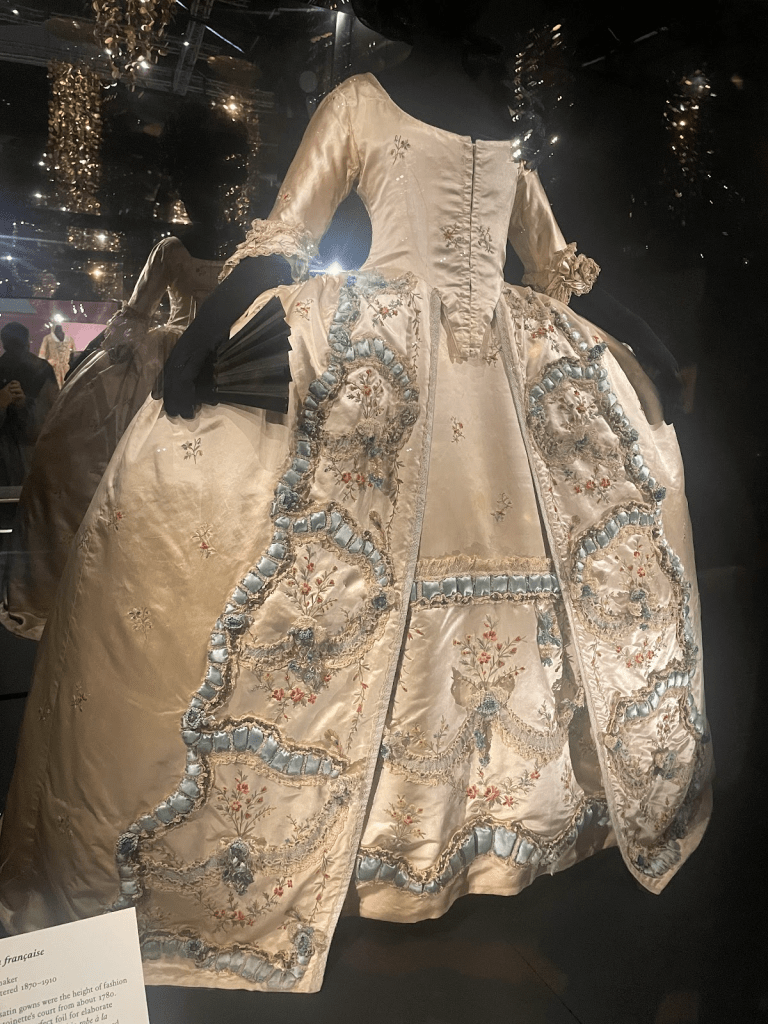

Image Credit: Josie Barry
Some of the exhibits are presented as a focus of impropriety, playing into the narrative curated around Antoinette. We are presented with ‘The Diamond Necklace Affair.’ A scandal in 1780s France, where the Comtesse de la Motte, a con artist, swindled jewellers by forging Marie Antoinette’s signature to obtain a very expensive diamond necklace meant for the Queen. Although Marie Antoinette was innocent and acquitted, the affair severely damaged her already tarnished reputation, making her appear extravagant and further discrediting the monarchy.

Image Credit: Josie Barry
Then followed the scandal of the Muslin dress. The caricature, wide hip dresses, more commonly associated with Antoinette (robe à la polonaise), made way for a softer silhouette as she matured, reflecting the affectation of her latest, country maid, incarnation. These flowing, muslin style dresses caused public outrage when a portrait of her wearing this informal style was exhibited at the 1783 Paris salon. The audience thought it looked like an undergarment. Despite,or because of, the scandal she had set another trend. But this then had an economic effect as the French opulent silks were now replaced with British cotton and affected their industries, gifting the masses another reason to despise her.

Image Credit: Josie Barry
Rumblings of Marie Antoinette’s decadence throughout her reign, peaked by the 1780s. Against a backdrop of instability across all aspects of French society, and stirred up by the pamphleteers, she was easily painted as the Wicked Queen. The trolling was vicious, even by today’s standards, Satirical sketches depicting the Queen in sexual acts (too pornagraphic to show you, Dear Reader) with a narrative that she was controlling an incompetent king. Add to this, Revolutionary propaganda, then ‘fake news’ morphs into their reality and she becomes the cause and figurehead of the country’s woes.
The tone of the exhibition continues to move away from the sparkles into a blood red soaked room, depicting the gruesome end to Marie Antoinette’s life. Alongside some macabre artefacts, (a ‘possible’ section of the guillotine and a death mask).
We’re told: ‘Marie Antoinette and Louis XVI attempted to flee Paris in 1791 but were discovered and arrested. This only increased public hostility, sealing their fate. The monarchy was abolished the following year and the royal family imprisoned. Marie Antoinette faced the Revolutionary Tribunal on 14 October 1793, was found guilty and sentenced to death. With shorn hair, bound hands and dressed all in white, the queen was guillotined at 12:15 pm on Wednesday, 16 October 1793. She was 37 years old. Her body was buried in the nearby Madeleine Cemetery where it remained until 1815 when it was re-interred in the royal crypt of the Basilica at Saint-Denis, Paris.’
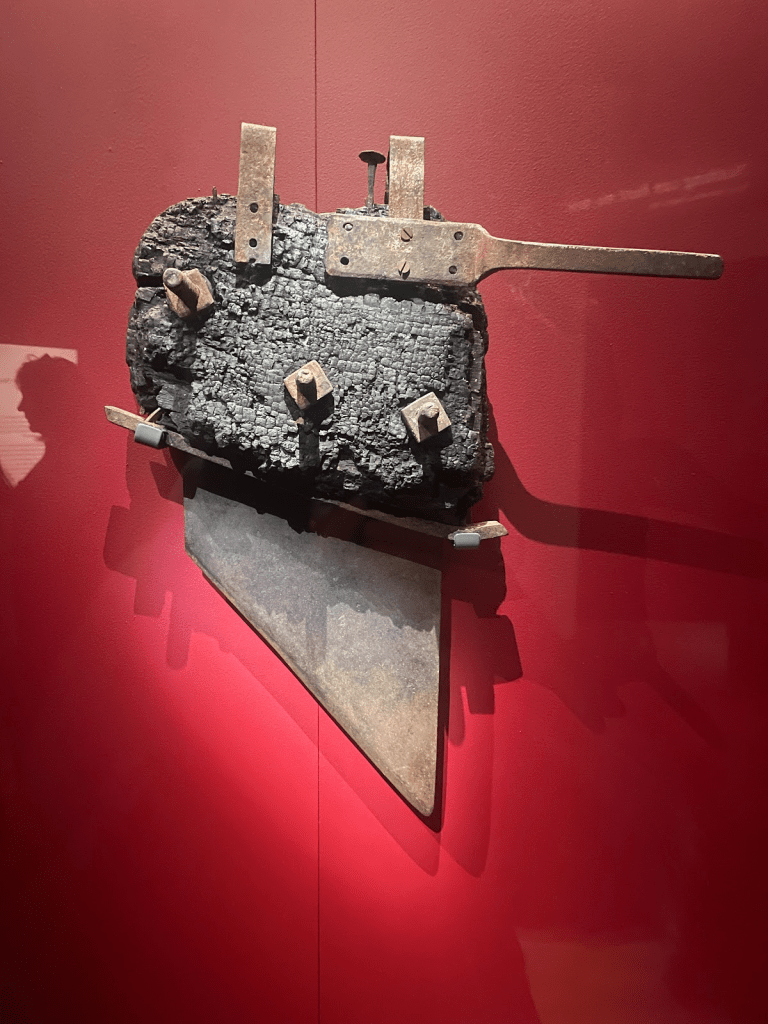

Image Credit: Josie Barry
Moving to the final room of the exhibition – I was emotionally whiplashed into my favourite section of the day. I have been fortunate enough to visit a variety of fashion exhibitions of some of the most iconic designers, so a couple of these geniuses’ collections came to mind as I meandered through the Antoinette collection. Walking away with relief from death masks and prison attire, I was catapulted into the light towards 21st century collections, heavily influenced by the Lady herself.
For me, nobody does it like John Galliano and I’ve always wondered if he was just born in the wrong century. Peerless in his attention to detail, even the print on the modern bustier dress was of a pixelated effigy of Marie Antoinette, taken directly from the V&A’s own 1773 portrait of the dauphine as a 17-year-old girl. The second garment, shaped in the recognisable robe à la polonaise, is adorned with a costume jewellery replica of the necklace from the infamous Diamond Necklace Affair of 1784/85.
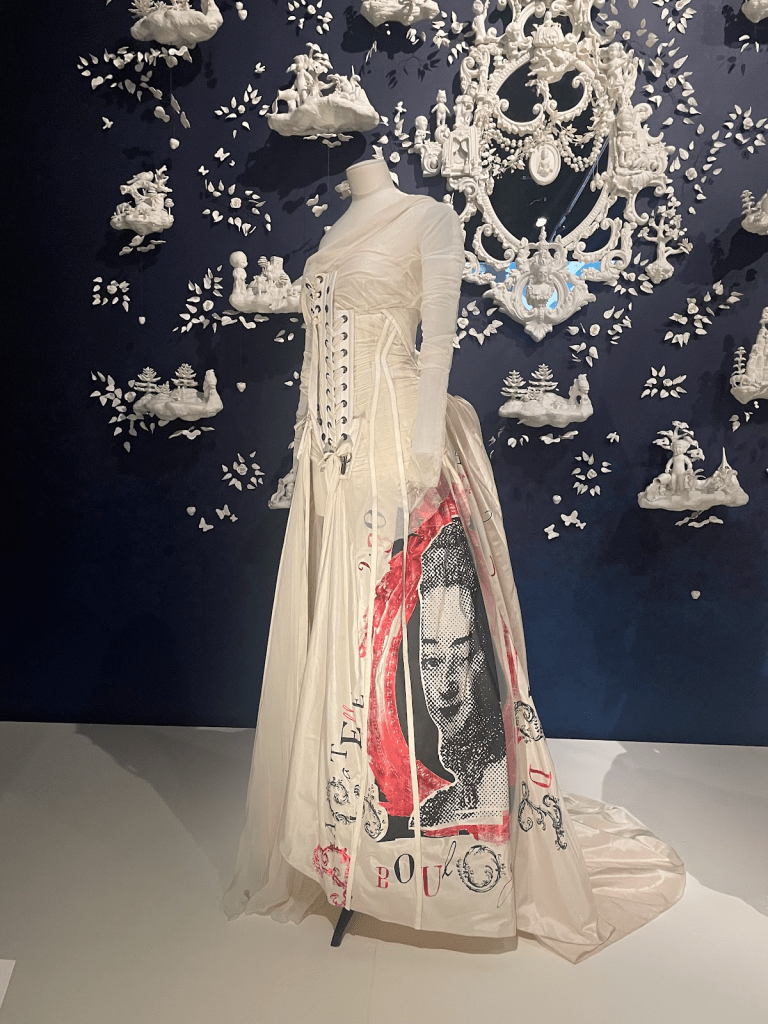

Image Credit: Josie Barry
Vivienne Westwood’s lace bridal ensemble, in her signature 18th century silhouette, was softened by delicate chantilly lace. Alessandro Michele for Valentino, delivered an abundance of bloom in the Antoinette-defined profile.
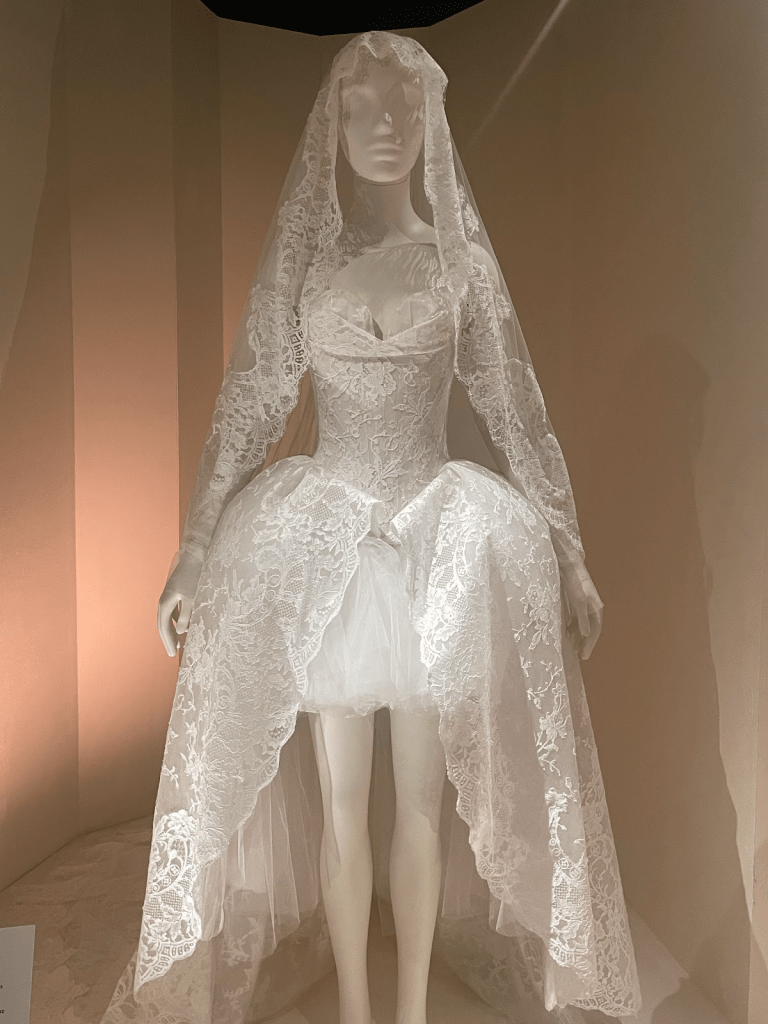

Image Credit: Josie Barry
Full circle with a delightful selection of fun and froth from Jeremy Scott for Moschino. What else could it be called but Let Them Eat Cake.

Image Credit: Josie Barry
There’s no denying that the exhibition is a spectacular collection of fashion, frivolity and fate for which she paid the highest price. So it’s fitting to finish with Marie Antoinette’s own, final words:
‘My God, have pity on me! My eyes have no more tears to cry for you my poor children; adieu, adieu!’
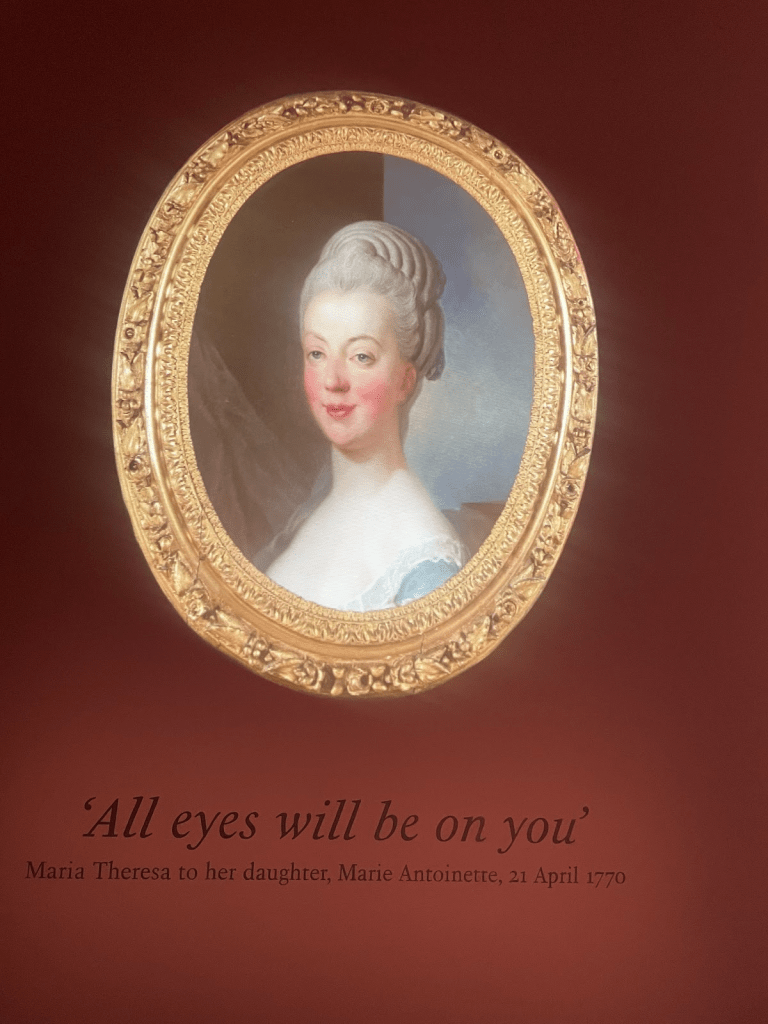
Image Credit: Josie Barry
Marie Antoinette Style
The V&A Museum South Kensington London
From 20th September
Weekday £23 Weekends £25 Members Free


Leave a comment