


Image Credit: Awesomely Luvvie (Creative Commons License applied)
Chloe Anthony Wofford “Toni” Morrison was an American novelist, famed for her striking portrayals of systemic racism in the US and her complex poetic prose. Her writing centres around issues of race and the female experience (particularly that of Black women), taking the form of lectures, novels, poetry, plays and even the libretto for a historical opera. Morrison’s profound contributions to the American literary canon have inspired and moved millions of readers in the US and beyond.
Born in 1931 to George and Ramah Wofford, institutional racism in the US was a spectre that haunted Morrison’s formative years. While she grew up in semi-integrated Ohio, she reported that her father witnessed lynching in Georgia prior to her birth, which traumatised him to the extent that he would not allow white people into the family home. When she was only two years old, their house was set ablaze by their landlord because they were unable to pay rent, an act she later referred to as a “bizarre form of evil.” In spite of the harrowing violence and discrimination the family endured, Morrison’s parents encouraged her to connect with her heritage and be proud of her race. She was introduced to traditional African-American songs, folktales and ghost stories at an early age, which shaped her literary endeavours.
After graduating high school, Morrison enrolled at Howard University in 1949, a historically Black academic institution in Washington D.C. There, she decided to change her name to “Toni” after the priest Anthony of Padua. During her time at Howard, she collaborated with key figures from the Harlem Renaissance movement, such as Alain Locke. She graduated with a bachelors in English, before moving to Cornell University to pursue her masters. Her master’s thesis explored the “treatment of the alienated” in the writings of two key modernists – Virginia Woolf and William Faulkner – arguably preempting the thematic core that her most famous works would centre around during her writing career.
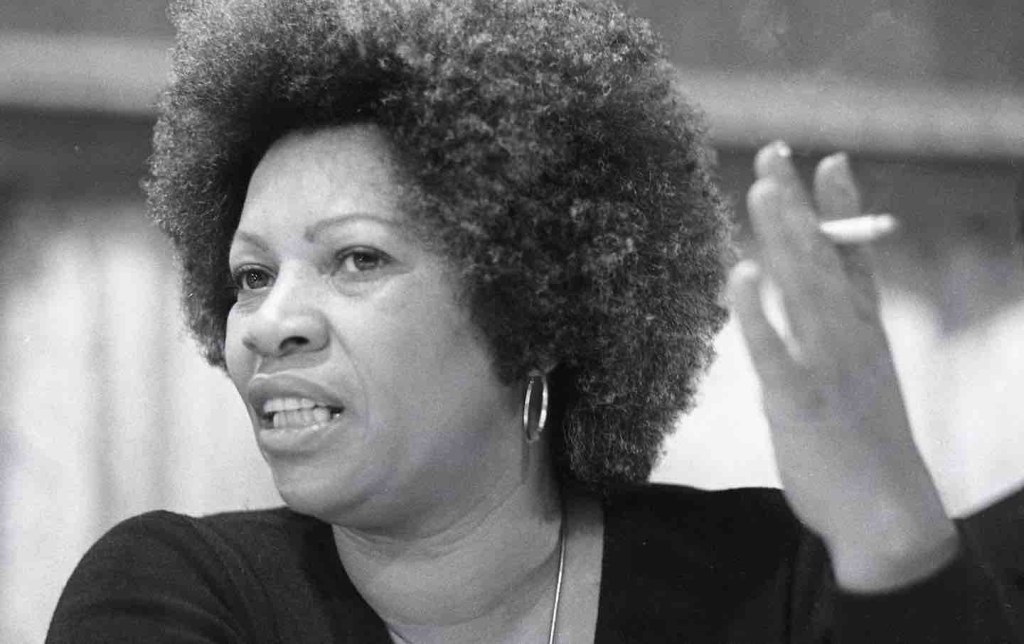
A young Toni Morrison. Image Credit: The Nation (Creative Commons License applied)
She was then offered a job lecturing at Texas Southern University in Houston, where she taught introductory English. One of her most notable students was Stokeley Carmichael, leader of the Student Nonviolent Coordinating Committee (SNCC) and later Honorary Prime Minister of the Black Panther Party during the Civil Rights Movement. In 1965, she began working as an editor for the textbook division of Random House Publishing. As a result of landing this role, she was able to push African-American literature into the mainstream. She assisted in the publication of Muhammad Ali’s autobiography, as well as poetry and prose collections that featured influential Black writers like Chinua Achebe. One of the most noteworthy contributions she made during her time with Random House was her collation of The Black Book (1974). This is a collage-like publication that documents the African-American experience in the US through historical artefacts, sheet music, photography, facsimiles and art. It was lauded by critics and historians, going on to receive an award from the American Institute of Graphic Arts.
Despite her dedicated contributions to the publishing industry, Morrison didn’t write a novel of her own until she was 39 – The Bluest Eye. Published in 1970, the text follows a young African-American girl called Pecola growing up during the Great Depression. Although it did not receive widespread critical attention upon publication, it is now a significant, canonical text in university literature modules interested in the Black experience and the perpetuation of structural racism in American sociopolitics. The Bluest Eye has proven a rather controversial novel; its sexually explicit content and incorporation of offensive language meant the book has been routinely banned by the American Library Association. Morrison has defended her motivations behind writing the text, stating its overt and shocking themes were intended to remind readers of how harmful racism truly is. In an interview, she asserted that she “wanted people to understand what it was like to be treated that way.”
The Bluest Eye’s successors – Sula (1973) and Song of Solomon (1977) – pushed her to heights of national prominence. The latter was a smash-hit, being both frontrunner for the ‘Book of the Month Club’ and winning the National Book Critics Circle Award; her success as a writer subsequently prompted her to resign from publishing to focus solely on her craft. She went on to publish Beloved in 1987, which is now deemed her most widely known and acclaimed novel. Beloved is a harrowing and yet beautifully written read, inspired by the true story of the runaway slave Margaret Garner. Rather than have her family be forced back into slavery after escaping, Garner was forced to kill her baby out of mercy. She was apprehended before she could kill any more of her children and trialled for infanticide. Morrison’s novel reworks this tragic historical narrative, imagining the baby (named ‘Beloved’) to return to her mother as a ghost during the post-emancipation period.
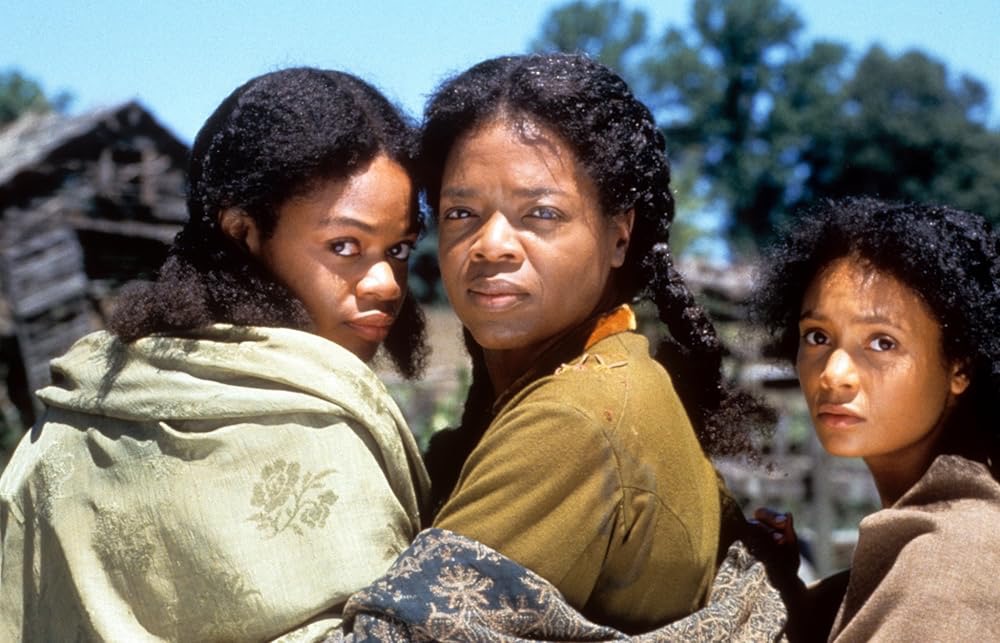
Still from the 1998 adaptation of Beloved. Image Credit: IMDb
Discussing Garner as her source of inspiration in Beloved’s foreword, Morrison acknowledged the limitations of objective historical accounts in representing the horrors of slavery: “The historical Margaret Garner is fascinating, but, to a novelist, confining. Too little imaginative space there for my purposes.” She then explained her motivations to make the “slave experience intimate” through her poetic language and the complex characterisation of Garner’s fictional counterpart ‘Sethe.’ The novel’s opening dedication honours the “sixty million and more” who died because of the Atlantic slave trade and the horrific ‘Middle Passage’; many literary critics see Beloved as a means of healing from and transforming the trauma of this blight in human history.
Beloved was then developed into a trilogy, with Morrison publishing Jazz in 1992 and Paradise in 1997. She also wrote her first piece of literary criticism in 1992, entitled Playing In The Dark. This explores the presence of African-Americans in white American literature, tracing the presentation of blackness in the work of classic authors like Edgar Allan Poe and Nathaniel Hawthorne. Time Magazine highlighted the lasting legacy of Playing In The Dark in American literary studies, claiming it was one of the most assigned texts on university campuses in 2016.
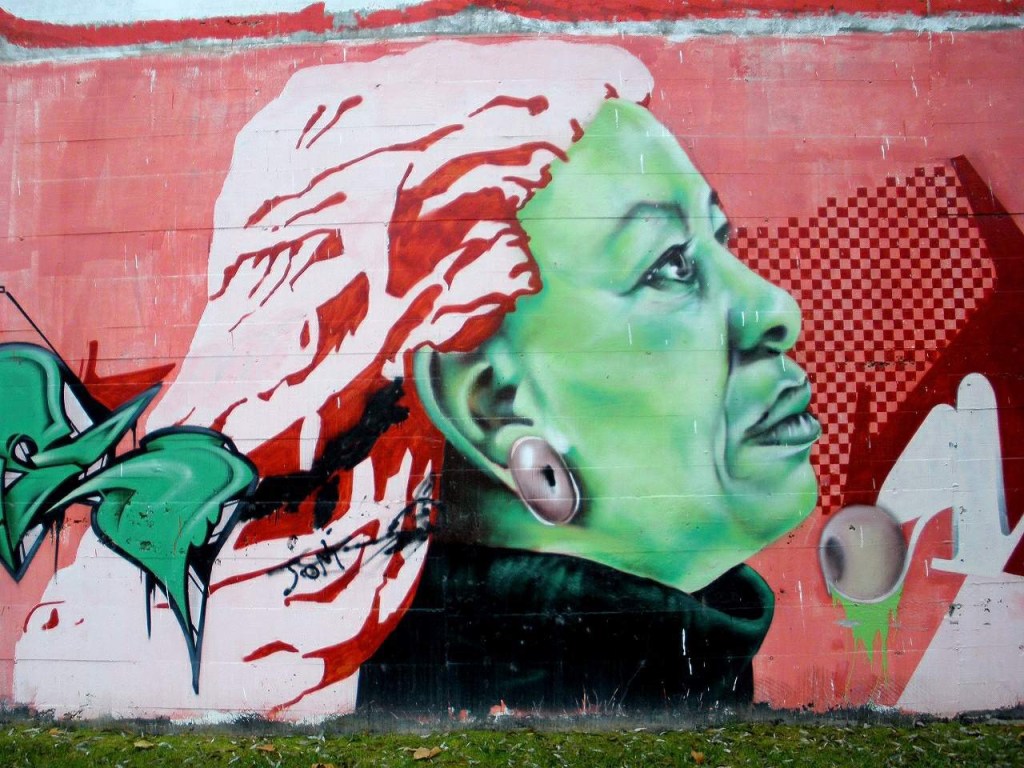
Toni Morrison mural in Spain. Image Credit: Wikimedia Commons (Creative Commons License applied)
In terms of American politics, Morrison’s voice has not gone unnoticed. She was outspoken about racial relations in the US, writing an article titled ‘Mourning for Whiteness’ upon Trump’s election in 2016. She argued that Trump voters were white Americans who were fearful of losing their privilege and were responsible for perpetuating white supremacy. Despite her complex relationship with the feminist movement, Morrison has often been cited as a significant contributor to Black feminism. Zadie Smith, author of White Teeth (2000), paid tribute to Morrison in 2019; she argued that the author opened up “infinite terrain” for young Black women and that “all readers and writers are indebted to her for the space she created.”
After a monumental life of writing, editing and activism, Toni Morrison unfortunately died from complications with pneumonia in August 2019. Her memorial tribute in November of the same year was attended by over 3000 people, showcasing the incredible impact she had on American citizens. She was eulogised by several prominent figures, including Oprah Winfrey and journalist and writer Ta-Nehisi Coates, who all commended her prolific authorship and her courage as a political changemaker. Toni Morrison’s ability to shed light on overlooked individuals and suppressed histories through her stunning prose has resonated with readers across the globe, cementing her as one of the most important authors of our generation.





Leave a comment