

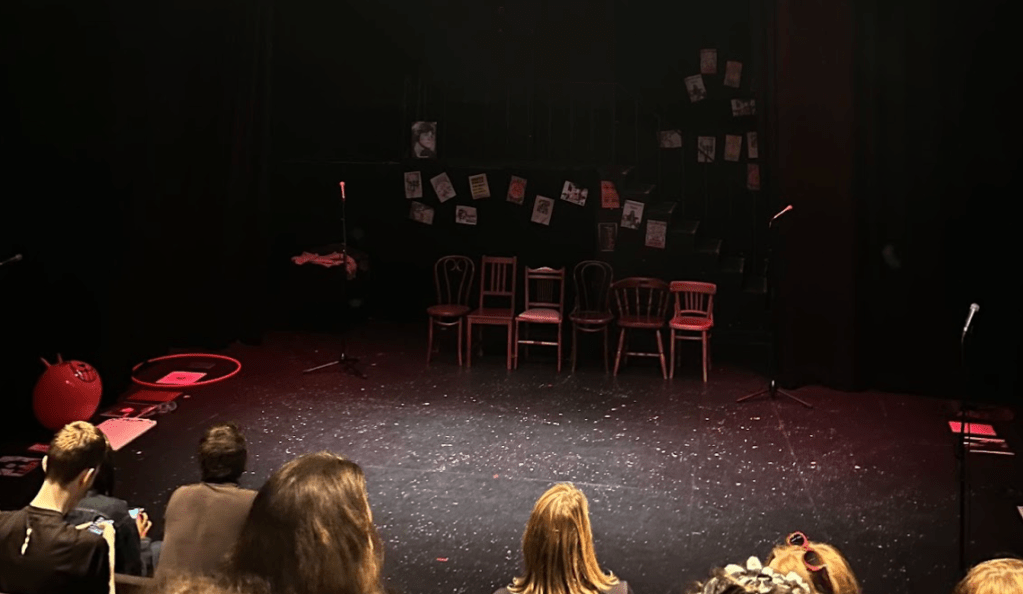
Image Credit: Esme Rose Mathialahan
The Theatre Royal York recently collaborated with the University of York Graduates in their new scheme: Launchpad. This is a prize designed to give young artists mentorship and experience working with a team of professional theatre makers. Launchpad performed ‘1972: The Future of Sex’ on 17 September 2025, at York Theatre Royal.
The play was originally devised by The Wardrobe Ensemble, suggesting it has a legacy of collaborative effort in its production. Set in 1972, it focuses on the first sexual experiences of three couples and one individual – Anton’s exploration of gender identity. But through narration and flash-forwards, it speaks to how changes in law impacted opinions and behaviours surrounding sexual relationships and how public opinion continues to change. The 1967 NHS Family Planning Act is an example of legislation that broadened accessibility to contraception, therefore affecting intimate relationships. The Launchpad Ensemble performed in Theatre Royal’s Blackbox theatre, where the audience viewed an intimate space with dark lighting and red highlights. Six chairs lined the back wall, and each corner was marked with a microphone. David Bowie’s music filtered through speakers throughout the production. The performance begins with a soundscape of recent historical and political moments, such as LGBTQ+ – particularly Trans Rights – parades, the overturning of Roe v. Wade in 2022, and the Supreme Court’s ruling on the definition of a woman on April 16 2025. This was effective in situating the audience within a continuously fluid aspect of society, providing perspectives on sex, identity, relationships, and gender as always changing.
The actors alternate between taking space in the middle of the stage area and narrating the scene from one of the microphones. This was particularly effective when projecting the narrative into the future, how this one night in 1972 is important for understanding changes in the culture of sex and relationships, as well as insight into how this one night informed the characters’ future decisions.
Christine, played by Shiwei Chen, has decided to sleep with Rich, played by Pippa Owen. The couple experiences their first love and struggles with the confusing and overwhelming emotions of love and lust in adolescence. Uncertain about what sex with Rich would involve, Christine frightens herself by watching a porn film for tips. She must learn to express what she wants and how she feels, rather than act on what the film portrays, or what she believes is expected of her.
Penny, played by Maddison Cox, has a growing curiosity in literary, political, and carnal topics of debate. She is drawn to her radical sociology teacher, Martin, played by Valeria Calderón. But Penny becomes disillusioned, and she must reconcile her romanticised view of Martin and her reality after they begin a relationship.
Anna, played by Jennifer Stead, visits a record shop in search of David Bowie’s music and finds she is drawn to another customer, Tessa, played by Harriet Lanham. The two share one night of sexual experimentation and sapphic love. We later see the two women, a few years older, as maternal figures accompanying children at a concert, but there is a clear rift between them.
Anton, played by Lee Barnes, has been looking through his mum’s wardrobe. He’s found that feminine clothes make him feel happy and confident. Anton explores his identity in the comfort of his room, before having to engage in a highly emotive scene with his father through an imagined bedroom door. Lee Barnes voices both Anton and Father, expressing anxiety and relief beautifully.
The Ensemble worked seamlessly together to voice thoughts and narrate sequences of each relationship’s progression, engaging in physical theatre movement and dance to visually represent intimacy. It was both effective in telling the story of the couples’ differing experiences and a source of humour in the clever choreography. There was a particularly brilliant moment where they used swimming gear and a space hopper. The play was hindered by its time restrictions, not allowing a great depth of character to be explored; however, the Launchpad Ensemble was a master of balancing tears and laughter to teach their audience a valuable message of sex, consent, acceptance, and love.



Leave a comment