


Image credit: John Hammond’s pamphlet, A most certain, strange and true discovery of a witch, 1643.
Samhain (pronounced “sah-win”) occurs on 31 October – 1 November. Originally a Celtic festival, it marks the end of summer and harvest. It is believed that the veil between the land of the living and the dead is thinnest on this one night – encounters with spirits are a potent risk. As a form of protection against the Otherworld’s denizens, sacrifices of crops or animals were burnt. Druids would tell fortunes around the bonfire, believing the veil’s weakness would make predictions easier. Costumes of animal and bestial nature were worn in the hopes that the spirits would be deterred.
As Christianity grew in popularity, the pagan festival was replaced by All Saints’ Day on 1 November and All Hallow’s Eve on the 31 October, in the 7th century. The celebration slowly evolved into the commercialised, candy-filled Halloween we know today.
Druidism and Wiccan have grown in popularity from the 18th century onwards due to curiosity in the supernatural from Celtic revivals in studies of mythology, folklore, and archaeology. They are strands of pagan faith, but exercise their beliefs in nature deities differently, and some argue Wicca is a purely 20th-century invention. Both view nature as sacred and practitioners honour cycles of the seasons, elements, and life’s interconnectedness. In mainstream culture, this is often referred to as witchcraft.
Pointed hats, stripey tights, and a faint air of malignant potion-making have been part of the Halloween aesthetic throughout my childhood. But in a culture of hyperconsumption and polyester, the cultural significance of Samhain has been diluted. We collectively trudge towards an insipid goal that The Capitalist manufactured; we are indifferent to the natural world around us.
The Witch has been a costume staple piece since the start of the 20th century due to popularised literature and film bringing the woman in the pointed black hat and broomstick to the forefront of visual media. Examples include the Wicked Witch of the West from L. Frank Baum’s novel The Wonderful Wizard of Oz and its 1939 film adaptation. Visual representations of witches didn’t start with pointed hats; however, 17th-century pamphlets depict women with head coverings under the title “Witch”. The printing press allowed the wide circulation of information about how to spot a witch, and it wasn’t until the Salem witch trials that pointy hats started to make an appearance. This is seen in books such as Cotton Mather’s The Wonders of the Invisible World, published in Britain in 1693, which defended his role in the trials and promoted the belief in the dangers of witchcraft.
Nowadays, many people have heard of the Salem witch trials, but I think fewer are familiar with Britain’s history of self-proclaimed witchfinders, trials, and torturers. Witchcraft was made a criminal offense under Henry VIII and Elizabeth I. This obsession with witchcraft continued throughout the 17th century under James I, who was fixated on finding and arresting anyone suspected of cavorting with the supernatural. He published a book on witchcraft titled Deamonologie in 1597, which elevated the status of witch hunting and set an example for the accusation and torture that swept through the country known as witch mania. This allowed men like Witchfinder General Matthew Hopkins to have power. According to The History Press, the most famous witch trial in British history was that of the Pendle witches at Lancaster Castle in 1612, where ten people were sentenced to death for witchcraft. During the trial, family members turned on each other, with accusations of the hexing and cursing of local people, and bearing the witch’s mark – proof of allegiance to the devil – were used as evidence. Lancaster is second only to London in the number of people hanged there, a dark city with a brutal past, which in 2012 commemorated 400 years since the trials. A statue of Alice Nutter, one of the Pendle witches, was erected in Roughlee.
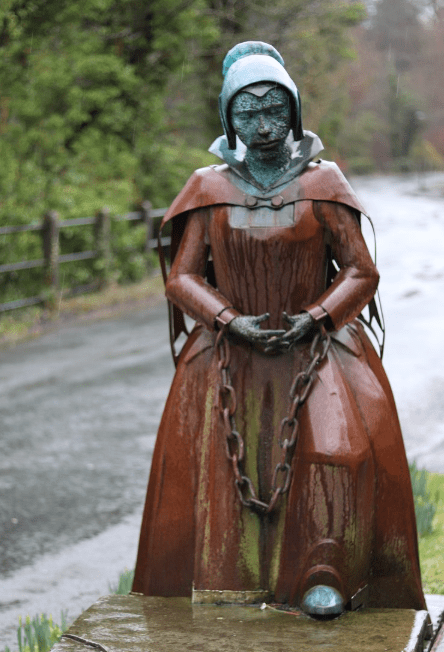
Image Credit: Tripadvisor
However, I can’t help but notice the red rust dress, paired with a paler-coloured head covering and the heavy chains shackling the woman’s wrists. An image that does not seem too dissimilar from Margaret Atwood’s The Handmaid’s Tale, a dystopian narrative about the strict patriarchal control over women’s reproductive rights and sexuality. The fictionalised State of Gilead, within which the narrative is set, has frighteningly similar policies to those of our current reality. Since Trump’s first inauguration in 2017, following Obama’s two terms in office, the political zeitgeist has undergone a definitive move to the political right, favouring conservative politics. Such as the overturning of Roe v Wade in 2022, strengthening platforms for anti-abortion rhetoric. On 16 October 2025, a Guardian article reported that Nigel Farage, leader of Reform UK (a far-right British political party scarily growing in influence), had been urged to explain why a US anti-abortion advocacy group had helped arrange a meeting with Trump administration officials in London, in March 2025. The alignment of British politicians with Trump demonstrates how the Western world’s identity of progressivism is an illusion. The movement of popular political thought towards conservative and restrictive policy is a terrifying threat to the rights and safety of women and marginalised peoples. The House of Commons published a research briefing on 4 July 2025, on the results of recent UK local elections, which found that Reform won 41 percent of seats up for election. It won a total of 677 seats and gained control of ten councils. This is the first time Reform (previously known as the Brexit Party) has controlled any councils in local government.
In a 2023 research project run by Women’s Aid, they found that one in four women (27 percent) have experienced domestic abuse since the age of 16. Despite the facts calling for desperate change to the social system, Reform UK does not have a focused policy aimed at improving standards of living, education, wages, or healthcare for women. Instead, the Reform party wants to leave the European Convention on Human Rights, and as reported by the BBC, this would lead to a lack of regulation of human rights and allow institutional prejudices to take precedence in the UK court system, allowing a systematic abuse of power.
Although Atwood’s fiction is rooted in American politics, her predictions about society’s trajectory on issues of feminism and equality seem to be validated each day. Atwood’s insight is not too dissimilar from the predictions made by those deemed guilty of ‘witchcraft.’ Restrictive policy on ethical belief, and faith – Gilead being a theocracy and Reform encouraging traditional British roots such as the Christian religion – seem reminiscent of Tudor anti-witchcraft laws. It begs the age-old question of whether the supernatural or the empowered woman poses danger to society’s patriarchal order.
‘Witch’ has been used as a term of abuse for a woman since 1475. From a Christian perspective, the word ‘witch’ was used to insult pagan practitioners, deeming them heathens. However, going back to the Pendle Family, it wasn’t until Robert Nowell, Pendle’s Justice of the Peace, was involved that it was deemed dangerous to interact with the Pendle family. In fact, they were known locally as witches, and it wasn’t unusual for the family to believe in magic and their use of it. Witch didn’t just mean ‘evil’ – it was interchangeable with healer and wise woman.
So, why is witchcraft relevant today, this Samhain? A witch is not a simple caricature but a figure tied to a gruesome history. The practice of witchcraft has its own rules, like any form of spirituality, but it also has a symbolic role in encouraging communities to unify under common beliefs and stand together against an oppressive force. Witchcraft’s focus on community is not too dissimilar from the sisterhoods of rebellion found throughout history (to name a few): the suffragettes, the National Association of Coloured Women, and the 4B movement in South Korea. Women have always needed a community to fight against oppression. Yet the infighting amongst women, the prejudice against women of colour, disabled women, working class women, transwomen, and queer women is getting louder and louder. Competition between friends can be a healthy rivalry, but it can also be a source of bitterness. Atwood’s Serena Joy betrays her gender, actively working for the state of Gilead, and subsequently suffers under its patriarchal rule. The Pendle family suffered greater losses because their daughters betrayed their mother, exposing their belief in magic to persecution. Until we are unified against jealousy, bigotry, and hate, the witch hunt will continue to rear its ugly head all the way to humanity’s extinction.
Andrea Dworkin wrote in her book Pornography: Men Possessing Women in 1981 that “the male does not merely name women evil; he exterminates nine million women as witches because he has named women evil.” Despite this analysis of gender relations being 44 years old, it seems a very apt description of our present day. Therefore, I encourage a reclamation of the word ‘witch’ this Samhain.



Leave a comment