

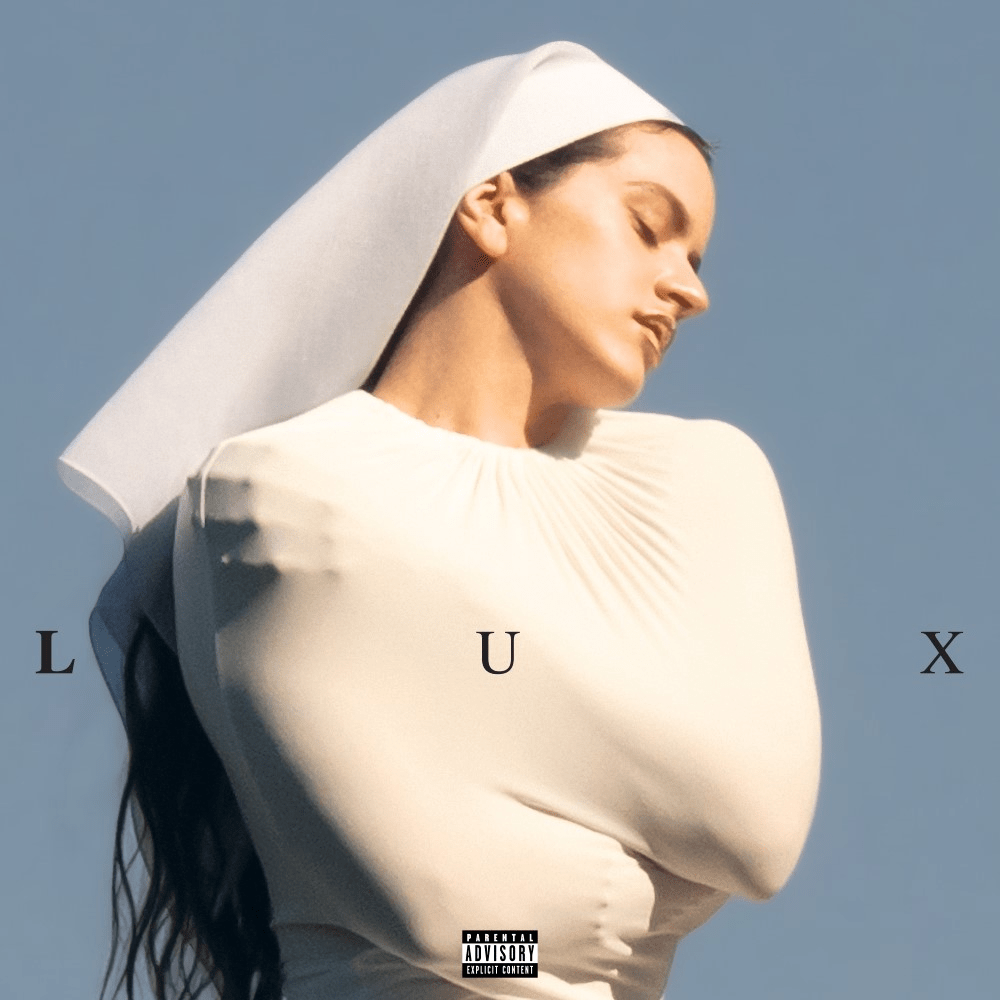
Image Credit: Columbia Records
All translations from STRØMMEN.
Rosalía has never been afraid of breaking boundaries. From her debut album Los Ángeles in 2017, taking inspiration from folkloric flamenco cantes, to her baccalaureate project second album El mal querer (2018), receiving critical acclaim for its experimental blending of flamenco melodrama and modern pop and R&B, to the more playful and daring mix of reggaeton and electronics in her 2022 record Motomami. The Spanish singer-songwriter returns three years later with her most ambitious project yet.
LUX is a spellbinding, boundary-crossing work, blending experimental pop and classical arrangements. The lyrics explore themes of “feminine mystique, transformation, and spirituality”, and inspirations for the songs include the lives of various female saints, such as Hildegard of Bingen, Rabia Al-Adawiya, and Miriam, as well as Rosalía’s own relationship with God, her romantic relationships, and works by Simone Weil and Clarice Lispector. Throughout the record (including the bonus tracks on the physical album), Rosalía sings in fourteen different languages, ranging from her native Spanish through to English, Catalan, Latin, Japanese, Arabic, Ukrainian, and many more. When asked about her intentions behind this she said: “I love traveling, I love learning from other humans. Why would I not try to learn another language and try to sing in another language and expand the way I can be a singer or a musician or an artist? The world is so connected.”
The first track, ‘Sexo, Violencia y Llantas’ (Sex, Violence, and Tyres), sets out the concept of the album. Rosalía enters heaven, representative of the exploration of saints throughout the record, and by the closing track ‘Magnolias’, returns to earth in a metaphorical death.
“Primero amaré el mundo y luego amaré a Dios
Quién pudiera venir de esta tierra
Y entrar en el cielo y volver a la tierra”
(First I will love the world and then I will love God
Who could come from this earth
And enter heaven and return to the earth)
‘Reliquia’ (Relic), the second track, is inspired by “Santa Rosa de Lima and how her reliquias are spread around the world”, and the lyrics see Rosalía singing about the things she leaves behind in the world as an artist, and the song is ultimately about the costs of fame, youth, and beauty. From there, in ‘Divinize’, she takes us to the Garden of Eden in a song about creation and blurred lines, primarily in the narrative and the separation between singer and narrator, but also through the two languages, Catalan and English.
‘Porcelana’ (Porcelain) makes use of four languages, Spanish, Latin, English, and Japanese, and features American rapper Dougie F, to reflect on sacrifice, beauty, and spiritual freedom. The lyrics are inspired by the story of the 17th century Japanese poet Ryōnen Gensō, who disfigured her own face to be accepted into a monastery. This song also gives us the album’s title in the Latin lyrics, “Ego sum nihil / Ego sum lux mundi” (I am nothing / I am the light of the world), returning to the theme of light as significant throughout the album. In more of a genre shift, ‘Mio Cristo Piange Diamanti’ (My Christ Cries Diamonds) takes the form of an Italian aria inspired by the spiritual and emotional relationship between Saint Francis of Assisi and Saint Clare of Assisi, focusing on platonic relationships and non-possessive love.
The sixth track, ‘Berghain’ (Mountain Grove), was the first promotional single from the album, featuring Björk and Yves Tumor for another heavily classical and haunting piece about carrying the darkness of the world. The singer explained: “We all have this forest of thoughts inside us where you could get lost. I’m not glorifying evil, but darkness is present in life.” We next move to the second single, ‘La Perla’ (The Pearl), a more playful and ruthless denouncement of “La decepción local / Rompecorazones nacional / Un terrorista emocional / El mayor desastre mundial” (The local disappointment / National heartbreaker / An emotional terrorist / The greatest disaster in the world). The recently released music video sees Rosalía dressed in various forms of protective sports gear, representing her desire to protect herself from heartbreak.
Track eight, ‘Mundo Nuevo’ (New World), while not having a lot of lyrics, features Rosalía simply wondering if she could find more truth in a new world. ‘De Madrugá’ (At Dawn) comprises lyrics in Spanish and Ukrainian, and is an older song written during the rollout of her second album El Mal Querer. While she frequently played the song on tour in 2019, she returned to the track to update it for LUX. It is inspired by Saint Olga of Kyiv, who was another part of Rosalía’s exploration and understanding of sainthood.
Next, in ‘Dios Es Un Stalker’ (God Is A Stalker), the singer writes from the perspective of God. As she explained in her Apple Music interview with Zane Lowe, doing so is an impossible exercise in any serious way, so it takes a humorous tone instead. ‘La Yugular’ (The Jugular) is inspired by Rabia Al-Adawiya, a poet, mystic, and influential Muslim saint from Iraq, taking her teachings to explore Rosalía’s relationship with God. The song ends on a recording of Patti Smith from a 1976 interview, where she speaks about always aspiring to more even after reaching success.
“Seven heavens, big deal
I wanna see the eighth heaven, tenth heaven
Thousandth heaven
You know, it’s like
Break on through the other side
It’s just like going through one door
One door isn’t enough
A million doors aren’t enough”
The twelfth track, ‘Sauvignon Blanc’, is a delicate piece focusing on material detachment and a dedication to “desiring less”: “Ya no quiero perlas ni caviar / Tu amor será mi capital” (I don’t want pearls or caviar anymore / Your love will be my capital). Next comes ‘La Rumba Del Perdón’ (The Rumba of Forgiveness), an ode to forgiveness, followed by the penultimate track ‘Memória’ (Memory), which is heavily inspired by Portuguese Fado music, and sees Rosalía asking herself about her life and memories.
Finally the album closes on ‘Magnolias’, in which Rosalía imagines her funeral as celebratory rather than sombre, and envisions her burial beneath magnolia flowers, inspired by Hindu mystic Anandamayi Ma, known for her flower-covered burial. The closer sees the singer return to earth after her journey through heaven to explore the lives and teachings of saints, and ultimately focuses on her desire for people to be happy and have a party rather than be sad about her death.
The physical album contains three bonus tracks: ‘Focu’ranni’ (Big Fire), ‘Jeanne’, and ‘Novia Robot’ (Robot Girlfriend). ‘Focu’ranni’ features lyrics in Sicilian and takes inspiration from Saint Rosalia of Palermo. While literally translating to ‘big fire’ the expression is used to describe a complicated or difficult situation, and in this song, Rosalía discusses ending her engagement. ‘Jeanne’ likens martyrdom to inner freedom, using the figure of Joan of Arc to explore faith, sacrifice, and identity. Finally, ‘Novia Robot’ takes inspiration from the Jewish prophetess Miriam and the Chinese poet Sun Bu’er in a punchy feminist track.
It is undeniable that Rosalía has a great talent for ambition and crossing boundaries, and LUX is an odyssey of an album that traverses the expanses of femininity, divinity, and spirituality. We can only wait to see what more the singer has in store, but for now, critics and fans alike can agree on one thing: Rosalía is a unique talent in the modern music industry.



Leave a comment