

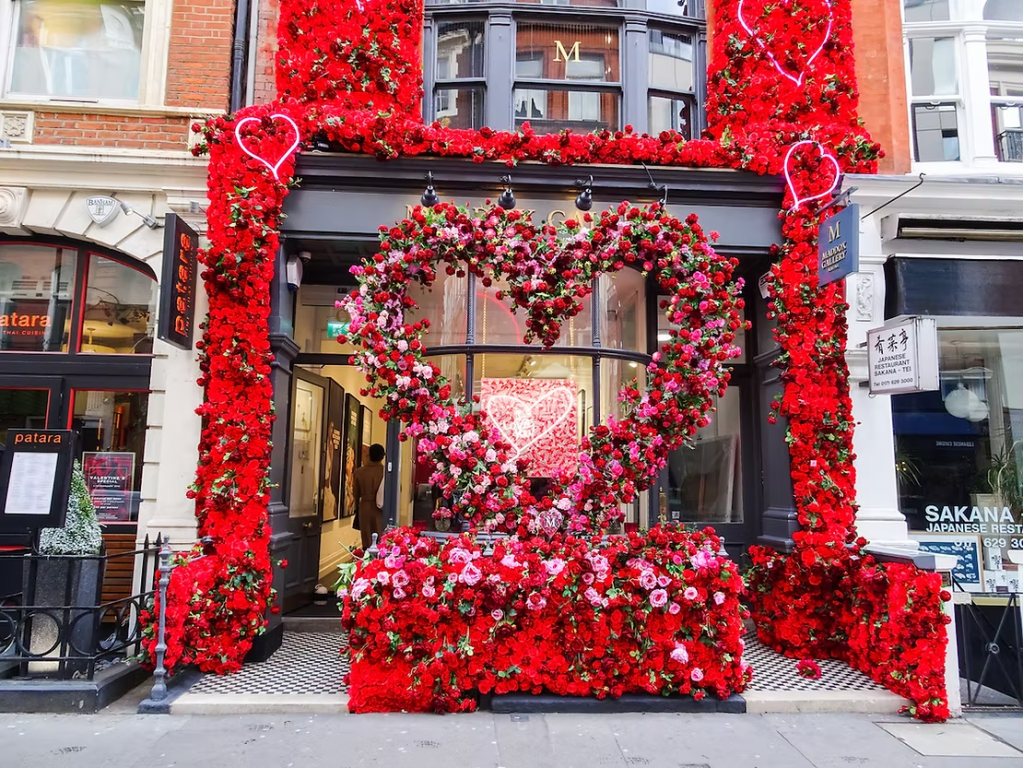
Image credit: Floristry Trade Club
Supposedly, it’s a day for celebrating one of the most important and complex things in the world: romantic love. Established as an ancient feast day for the martyred Saint Valentine, we latterly associate 14 February with romance. But a quick browse around any high street shop from mid-January onwards makes it clear that the true reason for this holiday isn’t a wholesome celebration of love, but rather one of another societal constant: money.
At the risk of sounding overly cynical, the contemporary iteration of Valentine’s Day is a deeply rooted social construct which equates purchasing and consumption with expressing affection. Many people feel that it is an expectation to buy romantic gifts such as flowers, chocolates, jewellery and cards for their significant other, and anything less shows a lack of thought, effort or commitment.
It is estimated that Hallmark, one of the world’s biggest gift card retailers, makes over $1 billion annually for the Valentine’s Day season alone. The media helps to create associations in our minds between 144 February and gift-giving, while businesses create supplies to cater for the demand for romantic gifts. According to Finder, it was predicted that the average Brit would spend £49 on Valentine’s Day in 2026, and 37.5 million people were expected to mark the occasion – that brings in at least £1.8 billion to the UK economy.
The celebration economy, as a term coined by Forbes, describes predictable increases in economic activity generated by holidays, major life events and cultural festivities. Retailers know that they will experience a flurry of activity in the lead-up to major calendar events, and can therefore hike their prices up to garner an even larger profit.
Peer-pressure plays a huge part in the way we celebrate this occasion. In our social media-saturated society, we are constantly bombarded not only with products but also people packaging their personalities, lifestyles and appearances into a “personal brand” for others to consume. Many people feel the pressure not only to buy and/or receive material objects as an expression of love, but to also externally express to the public that “I am loved” by posting about the occasion. This performative level of romance drives people to spend more in order to live up to expectations, thus creating a culture in which we are constantly competing to have the best gift, the best partner, and to be the most loved.
Overconsumption is a term which has been often thrown around lately to describe the excessive purchasing and usage of resources and goods which has a harmful impact on the planet. Typical Valentine’s gifts are often mass-produced in unsustainable conditions, and are rarely made to be used long-term. According to research by Ecoegg, this holiday generates 24,500 tonnes of plastic and cardboard waste each year in the UK. While we can take steps to make our celebrations more sustainable, such as by gifting useful items which will be used regularly, or sending digital cards rather than paper ones, the negative environmental impact is undeniable.
Single people were once free from the constraints of Valentine’s Day, however this would change with the emergence of the “Galentine’s Day” phenomenon. Coined as a term by Leslie Knope in Parks and Recreation, this unofficial holiday serves as a celebration of female friendships and solidarity. Surely it must be a good thing that our society, which for centuries has posited romantic relationships as the ultimate life goal, is finally realising that platonic relationships can be just as beautiful and impactful? Or is this expansion just a calculated tactic to further monetise all different types of love? The abundance of Galentine’s gifts and celebration ideas such as gift swaps and pottery painting, as well as self-care-oriented presents, shows that consumerism doesn’t care whether you’re single or coupled up; self-love is equally as profitable as the romantic kind.
All of these different aspects pose the question: are there other ways for us to express our love to each other on this special day, without feeding into consumerism? Though it may take a little extra time and effort to make, a handmade card or gift is infinitely more special than your average fare from Clintons. As for celebrating the day itself, shared activities, cooking a nice dinner together, going for long walks and board game nights are all ways to spend quality time together without breaking the bank and supporting the unsustainable practices of the celebration economy.
As the saying goes, you can’t put a price on love. While our society may continue to equate showing affection with consumerism, the most enduring aspects of a good relationship are the things which can’t be bought.





Leave a comment